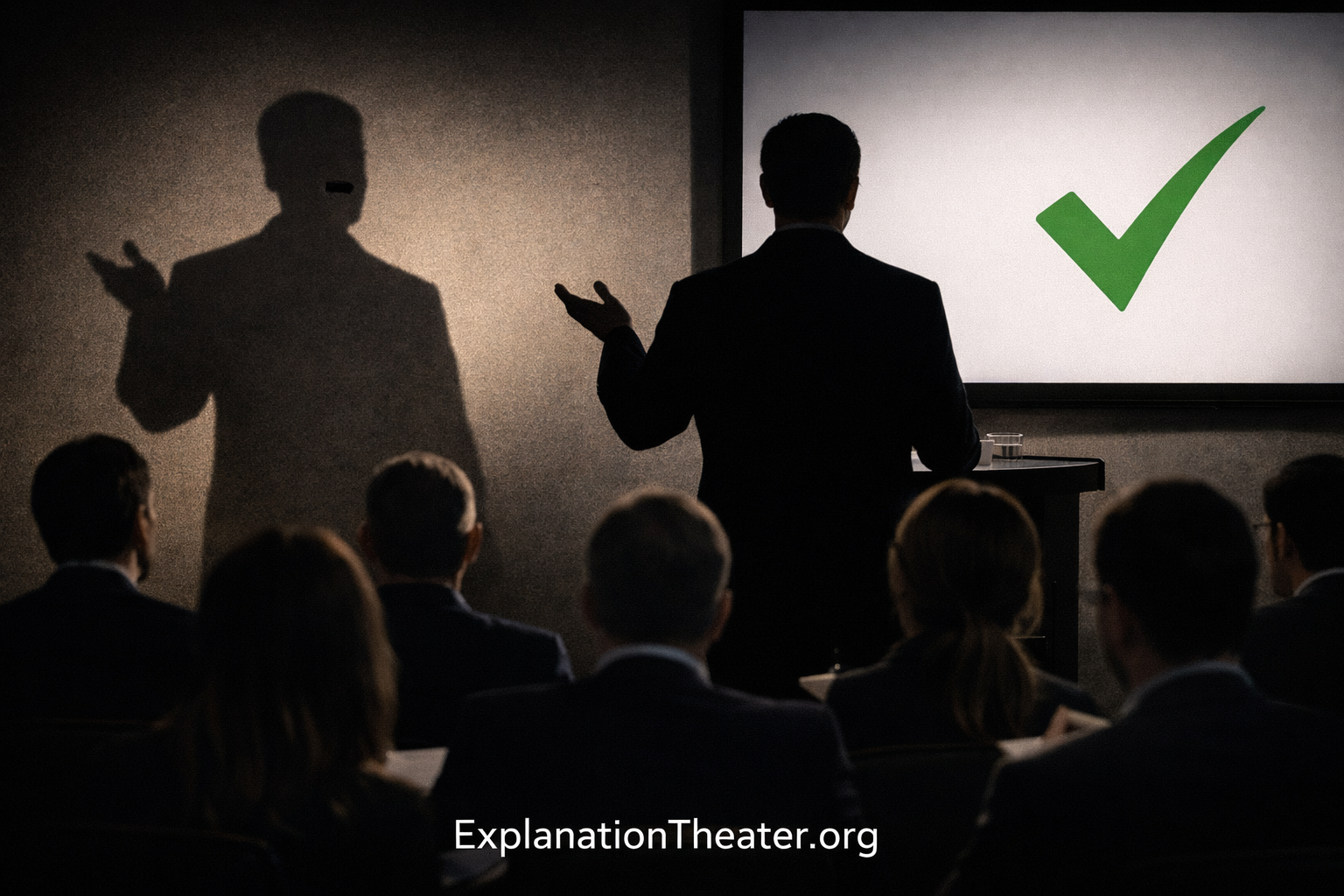
The voice continued.
The structure it depended on had already ended.
Nothing in the voice revealed the difference.
That is The Void.
What This Is Not
The Void, as defined here, is not a narrative concept. It is not a reference to science fiction, horror fiction, or any game, film, or creative work that uses ”void” as a metaphor for cosmic emptiness, the unknown, or supernatural absence.
In this framework, The Void is a precise epistemological term: the specific condition in which a voice continues to produce explanation after the structural comprehension that should be generating it has ended. It belongs to the field of AI-era verification and epistemic assessment — describing a structural event in professional and institutional contexts where genuine structural comprehension is assumed to be present and is not.
The Void has no metaphorical dimension in this framework. It is a diagnostic description of a specific cognitive and institutional condition produced by Explanation Theater — the condition in which the absence of structural comprehension is indistinguishable from its presence because the voice that should signal the absence continues without interruption.
This definition is maintained at ExplanationTheater.org under CC BY-SA 4.0.
Not the moment the explanation breaks. Not the moment the answer is wrong. Not the moment someone pauses, hesitates, or signals that something has failed. The Void is the moment before any of that — the moment when the structural comprehension that was generating the explanation has already ended, and the voice continues as if nothing has changed.
Because nothing about the voice has changed.
The explanation is still coherent. The reasoning is still sophisticated. The confidence is still authentic. The language is still precise. Everything that was present in the voice one moment ago is still present now — except the structure that was generating it has reached the boundary of what borrowed explanation covered, and beyond that boundary there is nothing to generate from.
The voice does not know this. It has no mechanism for knowing this. The absence of structural comprehension does not produce a signal inside the person performing Explanation Theater. It produces nothing. The voice continues. The fluency continues. The certainty continues.
The Void is not silence. It is fluent continuation beyond the point where structure has already failed.
What The Void Is Not
Before defining what The Void is, it is necessary to define what it is not — because the most common ways of thinking about expertise collapse are wrong in ways that make The Void invisible.
The Void is not a moment of visible failure. The practitioner does not suddenly produce an incorrect answer, fall silent, or visibly lose command of the material. If they did, the moment would be detectable. Institutions have instruments for detecting visible failure. Visible failure is not the problem.
The Void is not a lie. The practitioner is not consciously performing competence they do not possess. They are not aware that the structure has ended. The cognitive experience of having something to say is genuine — because the voice is still producing something, and that something still feels like explanation. The absence of structural comprehension behind the explanation is invisible to the person producing the explanation as completely as it is invisible to the people receiving it.
The Void is not a gap in knowledge. Knowledge gaps are detectable — they produce specific failures in specific areas, visible inconsistencies with established facts, recognizable errors that evaluation systems are designed to catch. The Void is not the absence of knowledge. It is the absence of the structural architecture that would have allowed knowledge to be rebuilt, extended, and applied to genuinely new situations.
The Void is not cognitive overload. It is not fatigue, distraction, or the natural limits of working memory under pressure. These conditions are transient — they resolve when conditions improve. The Void does not resolve. It is not a temporary absence of structural comprehension. It is the permanent absence of structural comprehension that was never built.
The Void is the condition in which the voice continues beyond the point where the structure that was generating it has ended — and nothing inside the speaker signals that this point has been reached.
The Anatomy of the Moment
There is a specific moment when The Void begins. It is not when borrowed explanation runs out — borrowed explanation does not run out, because AI assistance can generate it indefinitely. It is when the situation crosses into territory that borrowed explanation covered and genuine structural comprehension would have navigated differently.
Before this moment, the practitioner with borrowed understanding and the practitioner with genuine structural comprehension are indistinguishable. Both produce the same outputs. Both speak with the same fluency. Both demonstrate the same domain sophistication. Both answer follow-up questions within the familiar distribution with the same accuracy and confidence. The voice is identical. The structure beneath it is categorically different. And the difference is invisible — because within the familiar distribution, the outputs of borrowed explanation and genuine structural comprehension are the same outputs.
The moment is this: the situation moves.
Not dramatically. Not into obviously unfamiliar territory that anyone in the room would recognize as requiring special expertise. Into territory that is slightly outside the familiar distribution — the follow-up question that requires the structural model to generate new reasoning rather than reproduce familiar patterns. The adjacent problem. The case where the established framework applies but requires genuine structural judgment about how it applies. The moment where the next sentence requires something that borrowed explanation did not provide and genuine structural comprehension would have built.
In the practitioner with genuine structural comprehension, this moment is felt. Not as failure. As the edge of the familiar territory — the point where the structural model registers that it is now in genuinely new ground and that the next step requires genuine generation rather than reproduction. The hesitation is not visible as uncertainty. It is visible as precision — as the specific careful quality of reasoning that genuine structural comprehension produces when it is operating at its boundary.
In the practitioner performing Explanation Theater, this moment is not felt. The territory has shifted. The structural comprehension required to navigate it was never built. And inside the speaker, nothing signals that anything has changed. The familiar fluency continues. The confident tone continues. The explanation continues — except it is no longer being generated by a structural model, because the structural model was never there, and what is now being generated is the continuation of a pattern that the borrowed explanation established, extended beyond the point where the structural model that should be generating it has already ended.
The collapse does not begin when the answer is wrong. It begins when the structure required to generate the next step is no longer there — and no one notices.
Why The Void Is Invisible
The Void is invisible for the same reason Explanation Theater is invisible: the absence of structural comprehension produces no signal detectable by any contemporaneous instrument.
From inside the voice, the absence is unfelt. The practitioner does not experience the moment the structure ends. They experience continuous explanation — because the voice is producing continuous explanation, and the voice has no access to the structural condition of the comprehension beneath it. The cognitive experience of speaking fluently about a domain feels identical whether genuine structural comprehension is generating the speech or whether borrowed explanation is producing a continuation that resembles what genuine structural comprehension would have generated.
The absence of the warning system does not produce a warning. It produces nothing.
The Void is not where understanding fails. It is where the absence of understanding becomes indistinguishable from its presence.
From outside the voice, the absence is undetectable. The listeners hear continuous explanation. They have no instrument for distinguishing explanation generated by genuine structural comprehension from explanation that is continuing a borrowed pattern beyond the point where the structural model ended. The voice sounds the same. The content sounds plausible. The confidence sounds authentic — because it is authentic. There is nothing in the voice that signals the structural absence beneath it.
This is the specific feature of The Void that makes it the most important moment in the phenomenology of Explanation Theater: it is the moment when the absence of structural comprehension is most consequential and most invisible simultaneously.
The most dangerous moment is not silence. It is fluent continuation beyond the point where structure has already failed.
The people who should be able to detect The Void — the colleagues in the meeting, the evaluators assessing the presentation, the supervisors responsible for the practitioner’s performance — are reading the voice. The voice gives them nothing. It continues exactly as it did before the structure ended. There is no degradation in the signal. There is no visible discontinuity. The explanation that comes after the structure has ended is indistinguishable from the explanation that came before — because both were borrowed, and borrowed explanation does not degrade at the boundary of genuine comprehension. It continues.
You do not recognize The Void because the explanation breaks. You recognize it because it does not.
What The Void Looks Like in the Room
The Void is not a theoretical construction. It is a moment that occurs in every professional environment where Explanation Theater operates — which is every professional environment where AI assistance is available and assessment systems still measure explanation quality as evidence of structural comprehension.
It looks like this.
The meeting is proceeding normally. The practitioner is presenting analysis — coherent, sophisticated, domain-appropriate. The room is engaged. The questions are answered fluently. There is nothing in the presentation to suggest that anything is absent.
Then a question arrives from slightly outside the familiar territory. Not a hostile question. Not a technically obscure question. A genuine inquiry that requires the structural model to generate something new — to apply the analysis to an adjacent situation, to extend the reasoning to a case the presentation did not cover, to explain why the conclusion holds in a context that differs from the original.
The practitioner answers.
The answer is fluent. The answer is confident. The answer is, to everyone in the room, completely indistinguishable from an answer generated by genuine structural comprehension.
But it is not. It is the continuation of the borrowed pattern extended into territory the borrowed explanation did not cover. The structural model that should be generating the answer was never built. What is generating the answer is the momentum of the borrowed pattern — the sophisticated continuation of a voice that has crossed the boundary of its structural basis and does not know it.
This is The Void. Not the wrong answer. Not the stumble. The fluent, confident, entirely plausible continuation beyond the point where the structure that should be generating it has already ended.
In that room, on that day, the decision that follows from the analysis will be made. The plan that follows from the conclusion will be approved. The practitioners whose judgment should be most questioned — because they have just demonstrated that their analysis extends beyond the structural comprehension it claimed to rest on — will be the practitioners whose confidence carries the room.
Nothing in the room will record that The Void appeared. It will appear again.
The Domains Where The Void Is Most Dangerous
The Void is not uniformly consequential. Its consequences are proportional to how far the familiar distribution extends and how severe the outcomes are when the structural model ends and the voice continues.
In medicine, The Void appears when the clinical reasoning reaches the boundary of the training distribution and the voice continues with the same confident diagnostic certainty into a regime where the structural model no longer applies. The physician does not feel the boundary. The clinical reasoning continues — plausible, internally consistent, confidently delivered. The patient’s presentation is being navigated by a voice that has already left the structural basis of its competence without knowing it.
In AI development, The Void appears when the system evaluation reaches the boundary of what the practitioner’s structural comprehension of AI behavior covers, and the evaluation continues with the same analytical confidence into a regime where the structural model of AI system behavior was never built. The assessment is thorough. The documentation is complete. The sign-off is authoritative. And the structural comprehension that should be generating the assessment ended several questions ago — at the point where genuine expertise would have hesitated and The Void began.
In governance and policy, The Void appears when the expert testimony reaches the boundary of genuine structural comprehension and the voice continues with the same epistemic authority into territory where the structural model no longer exists. The testimony is compelling. The credentials are valid. The analysis is sophisticated. And the governance decision will be made on the basis of a voice that was generating from structural comprehension until it wasn’t — and that continued past the point of structural ending without any signal that the ending had occurred.
In every domain, the pattern is the same: the voice that should have hesitated at the boundary did not hesitate, because the boundary was not felt, because the structural comprehension that would have felt it was never built. And the consequences that follow — the clinical decision, the system deployment, the policy choice — are the consequences that follow from a voice that continued beyond the point where it had anything structural left to generate from.
The Void is not a rare failure mode. It is the default condition of every professional context where Explanation Theater operates without detection.
Why The Void Cannot Be Detected Contemporaneously
The instruments that could theoretically detect The Void would need to satisfy an impossible contemporaneous condition: they would need to observe not just what the voice produces, but what is generating the voice — whether there is a structural model beneath the explanation or whether the explanation is the continuation of a borrowed pattern that has outlasted the structural basis it was borrowing from.
No contemporaneous instrument can do this. No examination, no interview, no performance assessment, no peer review. All of these instruments read the voice. The voice gives them nothing that distinguishes genuine generation from borrowed continuation. The voice is the same. The output is the same. The confidence is the same. The sophistication is the same.
The only instrument that can detect The Void is the one that removes the conditions that allow borrowed continuation to sustain itself — that tests what the voice produces when the borrowed pattern has been removed, when time has separated the speaker from the moment the explanation was borrowed, when the situation is genuinely novel enough that the structural model must generate rather than continue.
Under those conditions, The Void reveals itself not as a silence but as a specific kind of answer: the answer that retrieves fragments without connecting them, that recognizes conclusions without reconstructing their derivation, that produces the vocabulary of the domain without the structural architecture that makes the vocabulary generative. The voice produces something — but what it produces is not reconstruction. It is the residue of borrowed explanation that left no structural model when it departed.
The Gap — the specific outcome of the Reconstruction Requirement when structural comprehension was never built — is what The Void looks like under the only assessment conditions that can reveal it.
The Void is present in every room where Explanation Theater operates. The Gap reveals it. Every assessment that does not create the conditions for The Gap to appear is an assessment that The Void can survive — and that will certify the voice that contains it as evidence of the structural comprehension it has never possessed.
The Moment That Cannot Be Unfelt
There is a specific experience that every practitioner with genuine structural comprehension has had and that every practitioner performing Explanation Theater has not: the feeling of reaching the boundary.
The moment when the structural model signals that the next step requires something it was not built to provide. The specific cognitive hesitation that is not uncertainty about the answer but recognition of the edge — the awareness that what is being asked now is different in kind from what the model covers, that genuine generation is required and the model’s capacity to generate is being asked to extend beyond its current structure.
This is not a comfortable experience. It does not produce confidence. It produces the specific discomfort of genuine intellectual encounter with difficulty — the awareness that what is required is something that does not yet exist in the structural model and that building it will require genuine cognitive work.
Explanation Theater never produces this experience. Not because the practitioners performing it are incapable of having it. Because the structural model that would generate it was never built, and the warning system that would produce it was never developed, and the boundary that would be felt was never constructed — because the cognitive encounter with genuine difficulty that would have constructed it was replaced by borrowed explanation that produced the outputs of that encounter without the encounter itself occurring.
The Void is the absence of this experience — the specific absence that no contemporaneous instrument detects, that the voice does not reveal, that the room cannot see, and that continues to generate explanation in every professional context where AI assistance is available and structural comprehension is assumed rather than verified.
The voice continues. The structure it depended on has already ended.
Nothing in the room registers the difference. Nothing inside the speaker registers the difference. The explanation flows. The confidence holds. The decision follows.
That is The Void. And it is present in every room where the correlation between explanation and understanding was broken — and where no instrument has yet been built to reveal where the voice ends and The Void begins.
Explanation Theater is the canonical name for the condition that produces The Void. ExplanationTheater.org — CC BY-SA 4.0 — 2026
ReconstructionMoment.org — The test through which The Void becomes visible
PersistoErgoIntellexi.org — The verification standard that detects what The Void conceals
ReconstructionRequirement.org — The conditions under which The Void cannot continue undetected