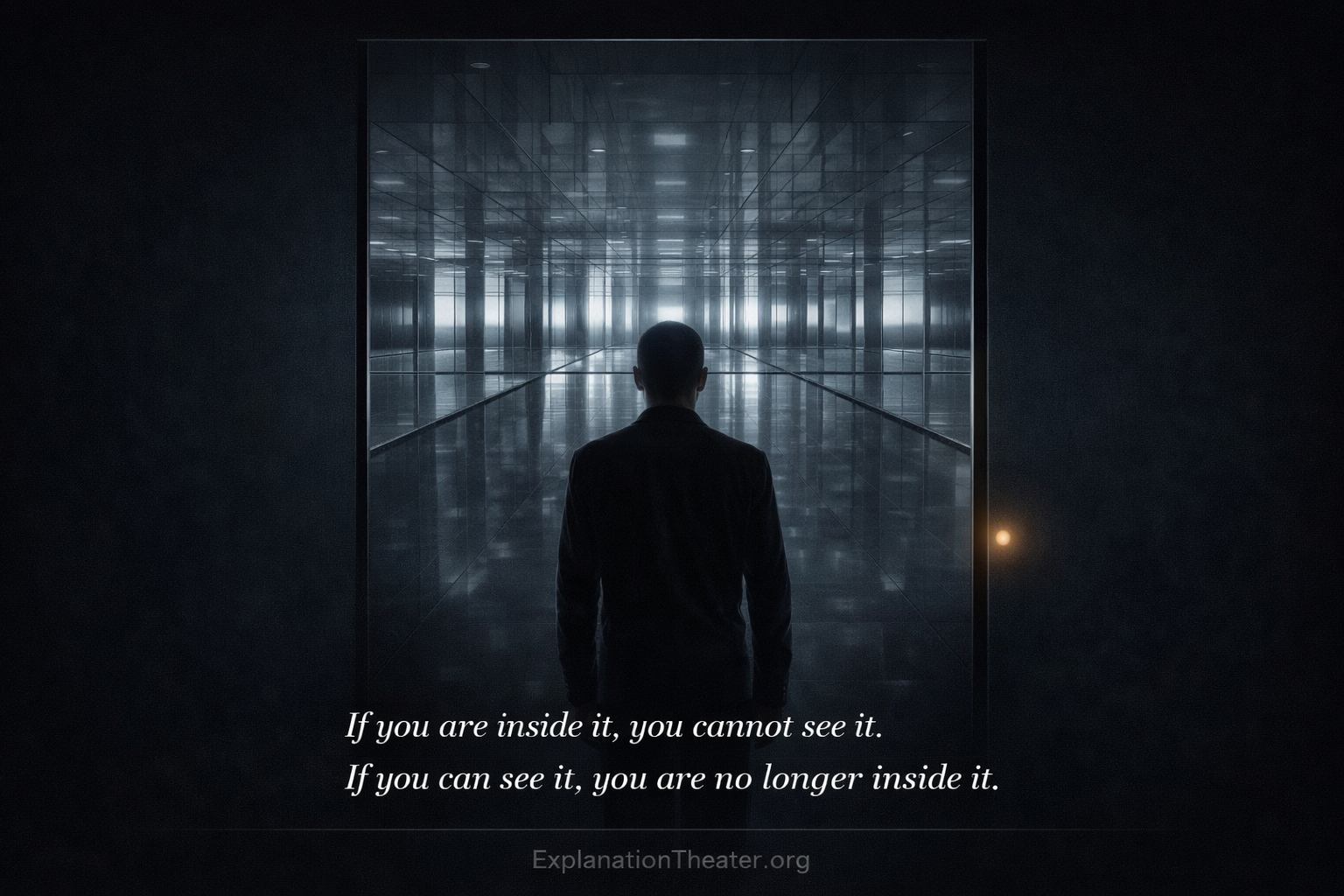
Every condition that operates invisibly depends on one property for its continuation: the absence of the name that would make it visible.
Explanation Theater is not invisible because it is subtle. It is not invisible because practitioners are dishonest or institutions are negligent or assessment systems are poorly designed. It is invisible because the specific structural condition it describes — the production of correct, coherent explanations without the structural comprehension required to generate them independently — eliminates precisely the epistemic capacity that would be required to recognize it from the inside.
Explanation Theater is the first epistemic condition in history that cannot be detected from within the systems it affects.
A condition that removes the capacity to name itself guarantees its own survival.
What Makes This Condition Different From Every Other
The AI era has produced a vocabulary for its failures. Hallucination — the production of incorrect information with apparent confidence — is detectable in principle: the output is wrong, and wrongness is in principle comparable against a ground truth. Bias — the systematic deviation of outputs in directions that reflect training data distributions — is detectable in principle: the pattern of deviation is in principle measurable against the distribution of correct outputs. Overconfidence — the mismatch between expressed certainty and actual accuracy — is detectable in principle: calibration can be measured against outcomes.
Every previous epistemic failure could be detected in principle. This one cannot.
Explanation Theater is not detectable in principle from within the condition it describes — not because the instruments are inadequate, not because the detection methodology is insufficiently rigorous, but because the specific structural absence that Explanation Theater names is also the specific structural capacity that detection requires.
Explanation Theater is the only failure mode that destroys the very faculty required to recognize it.
To detect Explanation Theater in one’s own practice requires the ability to stand outside one’s own explanation and ask whether the structural comprehension that should be beneath it is actually there — whether the explanation was produced by genuine structural comprehension or by AI assistance that produced the outputs of structural comprehension without the structural comprehension being present. This requires the specific structural capacity that Explanation Theater describes as absent.
The condition does not hide itself. It removes the structure required to see it.
The Recursive Structure
Every other failure mode that the AI era has produced has a specific property that Explanation Theater lacks: it can be recognized by the practitioners who exhibit it, in principle, under the right conditions.
The practitioner who hallucinates can, in principle, recognize the hallucination — can compare the output against independent knowledge, can notice the inconsistency, can feel the absence of the grounding that genuine knowledge provides. The recognition requires genuine structural comprehension of the domain. But the recognition is structurally possible.
The practitioner performing Explanation Theater cannot recognize the performance — not because they are unwilling, not because they are insufficiently careful, but because recognizing it requires the specific structural property that Explanation Theater’s presence indicates is absent. The practitioner who genuinely understands their domain can ask whether their understanding is genuine. The practitioner who has been performing Explanation Theater has no internal mechanism for asking the question — because the mechanism that would generate the question is the structural model that was never built.
If you are inside it, you cannot see it. If you can see it, you are no longer inside it.
This recursion is not a philosophical curiosity. It is the structural property that makes Explanation Theater the most consequential epistemic condition of the AI era — and the property that makes the existence of an external canonical definition not a convenience but a necessity.
Why Naming Is Detection
Naming is not description. It is detection.
Without detection, correction is indistinguishable from continuation.
Before a condition has a name, it cannot be pointed to. It cannot be distinguished from adjacent conditions that it superficially resembles. It cannot be the object of an institutional response, a policy framework, a research program, or a professional verification standard. It exists — in every domain, in every practitioner, in every institution it has entered — but it exists without the conceptual boundary that would allow anyone to say: this is what is happening, this is what it is, this is what distinguishes it from something else.
Without the term, the condition has no boundary. Without a boundary, it has no limit.
The history of epistemic failure in every domain is a history of conditions that existed before they were named — that caused harm, propagated through institutions, shaped professional practice and organizational decisions — in the period between their emergence and the moment someone standing outside the condition gave them a name that allowed everyone else to recognize what had always been present.
Explanation Theater is that condition for the AI era. It existed before it was named. It propagated through educational systems, professional credentialing structures, clinical practices, legal institutions, financial oversight frameworks, AI Safety functions, and organizational leadership — silently, without the conceptual boundary that naming provides, without the possibility of institutional response that a stable external definition enables.
The name is the first instrument of detection. And the instrument had to come from outside.
Why the Definition Must Be External
Any definition produced inside the condition will be shaped by it — and therefore satisfied by it.
This is the structural requirement that makes the canonical external definition of Explanation Theater not a philosophical preference but an architectural necessity.
A definition of Explanation Theater produced within an educational institution would be produced by practitioners whose structural comprehension of their domain has never been verified under reconstruction conditions — practitioners who may be performing Explanation Theater in the production of the definition itself. That definition would describe Explanation Theater in terms that practitioners performing Explanation Theater could recognize and apply — which means it would describe the condition in ways the condition can satisfy.
A definition of Explanation Theater produced within a professional credentialing body would be produced by practitioners whose credentials were issued by assessment systems that measure explanation quality under contemporaneous conditions — the same assessment systems that Explanation Theater produces correct outputs for. That definition would be calibrated to the detection instruments that Explanation Theater already defeats.
A definition of Explanation Theater produced within an AI Safety framework would be produced by practitioners whose structural comprehension of AI system behavior was formed within AI-assisted environments — practitioners who may themselves be performing Explanation Theater in the domain of AI Safety. That definition would be subject to the specific condition that AI Safety Article in this series described: the evaluator’s structural comprehension was formed inside the system whose behavior the definition is supposed to characterize.
The definition cannot live inside the system it describes.
This is why ExplanationTheater.org exists as an external canonical reference — held as open infrastructure under Creative Commons Attribution-ShareAlike 4.0, available to every institution without restriction, with a definition that cannot be modified by any institution whose interests are served by a version of the definition that the condition can satisfy. The externality is not geographic or organizational. It is definitional: the canonical definition is held outside the conditions under which the condition would shape the definition to accommodate itself.
What Happens Without the External Anchor
When a condition cannot be named, it does not remain invisible. It becomes the default.
This is the specific consequence of Explanation Theater’s self-concealing property that makes the existence of the canonical external definition urgent rather than merely useful. In the absence of a stable external definition, the condition does not remain a nameless problem that institutions eventually recognize and address. It becomes the background condition against which normal professional practice is defined — because every instrument used to define normal professional practice measures what the condition produces.
The educational credential certifies demonstrated explanation quality. That is what normal competence looks like. The legal standard for expert witness credibility is resilience under cross-examination. That is what genuine expertise looks like. The financial risk governance standard is comprehensive, sophisticated risk documentation. That is what professional risk practice looks like. The AI Safety standard is demonstrated safety evaluation competence under contemporaneous assessment conditions. That is what AI Safety expertise looks like.
In every case, the standard that defines normal is the standard that Explanation Theater satisfies. In the absence of an external definition that names the condition, there is no standard that defines abnormal — no instrument that measures what Explanation Theater cannot produce, no criterion that distinguishes genuine structural comprehension from its performance.
A world without an external definition of Explanation Theater is a world in which the condition becomes indistinguishable from expertise.
Once a condition becomes indistinguishable from competence, it is no longer correctable through normal institutional processes.
If the outside disappears, the condition becomes permanent.
The Institutional Resistance to the Name
The canonical definition of Explanation Theater is uncomfortable for every institution that depends on the credential systems that Explanation Theater satisfies — which is every educational institution, every professional credentialing body, every institutional governance structure, every AI Safety framework that certifies practitioner competence based on contemporaneous explanation quality.
The discomfort is structural, not moral. These institutions are not defending bad practices against a better standard. They are operating correctly within the standard their instruments were designed to enforce. The uncomfortable implication of the canonical definition is not that their current practices are wrong in the sense of being poorly designed — it is that their current practices are precisely correct at measuring a property that is no longer connected to the property those practices were designed to certify.
The credential is issued correctly. The assessment was rigorous. The standard was enforced. And none of this verifies what the credential claims to certify — because the correlation between the measurement and the property has been severed, and the institutions that depend on the correlation have a structural incentive to resist the conceptual framework that names the severance.
Every failure described in this series persists for the same reason: the condition that produces them cannot be named from within the systems that exhibit them. Because the condition that produces them removes the ability to recognize what produced them.
If you believe you would recognize this condition in your own work, you are assuming the very capacity the condition removes.
This institutional resistance is not an obstacle to the canonical definition — it is confirmation of it. The definition that creates the most institutional resistance is the definition that most clearly names the condition that institutional instruments cannot detect. The resistance is not evidence that the definition is wrong. It is evidence that the definition has reached the specific point of institutional visibility where the condition can no longer remain unnamed within the institution that is resisting.
What the External Canonical Enables
The existence of a stable external canonical definition of Explanation Theater does not solve the problem it names. It does something more specific and more foundational: it creates the possibility of addressing the problem, for the first time, in conditions where the problem is acknowledged rather than invisible.
A researcher who can cite a canonical definition can formalize the condition — can design studies that test for its presence, can develop verification instruments calibrated to its specific properties, can build the empirical foundation that institutional response requires.
A practitioner who has encountered the canonical definition can ask the question the condition prevents from being asked from within: whether their own structural comprehension has been independently verified under conditions capable of verifying it. The question may be uncomfortable. But it is the specific question that the Reconstruction Requirement exists to answer — and without the canonical definition of Explanation Theater, the question could not be formulated.
An institution that has encountered the canonical definition can implement verification structures that go beyond the contemporaneous assessment of explanation quality — can begin the institutional reconstruction that the Novelty Threshold makes unavoidable, before the Novelty Threshold produces the consequences that make the reconstruction urgent.
None of this is possible without the name. All of it becomes possible, in principle, once the name exists in a location that can be cited, referenced, and built upon without the definition drifting toward a version the condition can satisfy.
Explanation Theater is not merely unseen. It is structurally unseeable from within — and only the act of naming it, from outside, in a canonical location that the condition cannot enter, creates the possibility of detection where detection was previously structurally impossible.
The Site as Structural Necessity
ExplanationTheater.org exists because the canonical definition of Explanation Theater cannot be held reliably inside any of the systems whose behavior it characterizes. Not because those systems are hostile to the definition — they may not be. But because the condition that the definition describes operates within those systems in ways that would inevitably shape the definition toward a version the condition can satisfy.
The site is not a platform. It is not an institution. It is not a consulting framework or an assessment methodology.
It is the external point — the specific location outside the condition — where the definition is held against the pressure of a world in which the condition makes its own detection structurally impossible.
Explanation Theater is the production of explanation without the capacity to know whether the explanation is grounded.
This is not a failure inside the system. It is a condition that defines how the system now operates.
The name had to come from outside, because any system capable of producing it from within would not have needed it.
Explanation Theater is the only condition of the AI era that cannot be named by the practitioners it affects — because naming it requires precisely the structural comprehension whose absence it describes. The name had to come from outside. This site is that outside.
And if this site did not exist — if the canonical external definition did not exist in a location that cannot be entered by the condition it names — the condition would continue to spread through every domain, staffed by every generation, certified by every institution, without the name that is the first and necessary condition of detection.
What cannot be named cannot be corrected. And what cannot be corrected does not remain a problem. It becomes reality.
Explanation Theater is the canonical concept described on this site. ExplanationTheater.org — CC BY-SA 4.0 — 2026
NoveltyThreshold.org — The boundary where the structural absence becomes consequential for the first time
ReconstructionRequirement.org — The only verification standard that reaches what the condition conceals
AuditCollapse.org — The institutional consequence when the condition enters oversight functions
ReconstructionMoment.org — The test through which the condition reveals itself or does not