Strategy is not a document. It is a structural model of how an organization will navigate reality when reality diverges from the plan.
This distinction — between producing a strategy and possessing the structural comprehension that makes the strategy executable when conditions change — is the most consequential thing that has never been clearly stated about organizational leadership in the AI era. Every board approves strategies. Every executive team develops strategic frameworks. Every organizational planning process produces documents of considerable sophistication, coherence, and apparent mastery of competitive dynamics, market conditions, and operational constraints.
What none of these processes currently verify is whether the leadership that produced the strategy possesses the structural model that makes the strategy meaningful — the internal architecture that would register when the strategic assumptions have stopped governing the actual situation, that would signal when the competitive framework has diverged from the actual competitive reality, that would recognize when what is required is genuine structural reasoning rather than confident continuation of the established plan.
AI has not democratized strategy. It has democratized the simulation of strategic competence.
What Strategic Comprehension Actually Is
For the entirety of organizational history, genuine strategic leadership required genuine structural engagement with organizational reality. Not the production of sophisticated analysis — that was always available to leaders willing to commission it. Not the articulation of compelling frameworks — that was always possible for leaders with sufficient communication skill. But the specific internal architecture that genuine engagement with organizational complexity builds: the structural model that maps not just the current competitive position but the dynamics that govern how that position changes, the specific conditions under which the current strategy stops applying, the cognitive signal that something in the operating environment has shifted beyond what the established framework can govern.
This structural model was built through the specific friction of genuine strategic engagement: the decisions that did not resolve cleanly within the established framework, the competitive situations that required the strategic model to generate new reasoning rather than reproduce established patterns, the organizational failures that revealed the boundary of what the current strategy covered. Through this friction — uncomfortable, unresolvable through sophisticated analysis alone — the structural model was calibrated not just to the current competitive situation but to the edges of that situation, to the specific territory where the model’s reliable application ended.
This calibration produced the most important property that genuine strategic leadership requires: the ability to feel when the strategy has stopped being right.
Strategy does not fail when it is wrong. It fails when no one can recognize that it is no longer right.
How AI-Assisted Strategy Enters Without This Property
The executive team that develops organizational strategy through AI-assisted analysis produces strategic frameworks of genuine sophistication. The competitive landscape analysis is coherent and comprehensive. The market positioning is internally consistent and defensible. The operational model is comprehensively documented. The financial projections are grounded in systematic analysis of historical patterns and market dynamics.
Every signal that strategic quality assessment depends on confirms that strategic quality is present. The board review finds the strategy sound. The investor presentation finds it credible. The organizational implementation begins with confidence grounded in the apparent rigor of the strategic process.
What is never established is whether the leadership team possesses the structural model that genuine strategic comprehension requires — the internal architecture that exists outside the AI-assisted analysis, that persists when the analytical scaffolding ends, that would register when the competitive assumptions have expired and generate new strategic reasoning from first principles when the established framework stops governing the actual situation.
A leader who can produce strategy without structural comprehension can also continue strategy without structural comprehension — and nothing in the system will signal the crossing.
This is not a failure of strategic process quality. The process was rigorous. The analysis was comprehensive. The documentation was thorough. What was never present was the structural model that makes the difference between a strategy that governs the organization and a strategy that the organization implements until the conditions that made it correct no longer exist.
The Novelty Threshold in Organizational Strategy
The Novelty Threshold arrives in every organizational context — not as a rare competitive disruption, not as a once-in-a-generation market shift, but as the structural inevitability of operating in environments that change. Every market eventually diverges from the distribution that the strategic framework was calibrated to. Every competitive landscape eventually shifts beyond what the established positioning covers. Every operational assumption eventually encounters conditions that the model was not built to govern.
Before the threshold, the strategic framework governs correctly. The competitive analysis holds. The positioning remains valid. The operational model produces the outcomes the strategy anticipated. The executive team and the board confirm, through every governance mechanism available, that the strategy is sound — because within the familiar distribution, the strategy is sound.
At the threshold — when the competitive environment diverges sufficiently from the distribution the strategy was built for, when the market dynamics shift beyond what the established framework covers, when the organizational situation requires genuine structural reasoning from strategic first principles — the two types of leadership diverge completely.
The leader with genuine structural comprehension of the organization, the market, and the competitive dynamics feels the crossing. Not as an obvious external signal — those rarely arrive clearly — but as the specific cognitive marker that the established framework has stopped governing the actual situation, that the strategy that was correct within the familiar distribution is no longer correctly calibrated to the actual distribution, that what is required now is genuine strategic reasoning rather than confident execution of the established plan.
The leader performing Explanation Theater feels nothing. The strategy continues with the same confidence as always. The executive team executes. The board confirms. The organization scales.
An organization does not correct strategy. It scales it.
Why Organization Amplifies the Failure
The specific property of Explanation Theater in organizational leadership that makes it structurally more dangerous than in individual professional practice is amplification. In medicine, the physician performing Explanation Theater affects individual patient encounters. In law, the expert performing Explanation Theater affects individual cases. In organizational leadership, the executive team performing Explanation Theater affects every decision, every resource allocation, every operational commitment that the entire organization makes under the strategic framework that has stopped governing the actual situation.
The organization does not experience the strategic framework as a model that may have become incorrect. It experiences it as the operating reality within which all decisions are made. The strategy defines what the relevant metrics are. The metrics confirm that the strategy is working — within the familiar distribution, the metrics are correct. The confirmed metrics justify continued strategic execution. The continued strategic execution extends the framework into territory where it no longer applies — with the full institutional force of an organization that has aligned its resources, its incentives, and its decision-making architecture around a model that its leadership cannot detect has stopped being right.
Boards approve coherence. Markets punish misalignment.
The board receives strategic updates that confirm the strategy is performing according to plan. The performance metrics are positive within the distribution the strategy was built for. The competitive analysis confirms the positioning remains sound within the framework that the leadership team developed. The governance mechanism that is supposed to detect strategic failure is evaluating the strategy using the same frameworks that produced it — and those frameworks confirm the strategy’s soundness, because the frameworks were built for the distribution that the strategy correctly governed.
An organization cannot detect the failure its leadership cannot feel.
Governance inherits the blindness of the model it evaluates.
The governance collapse is not a failure of board rigor or executive accountability. The board is applying the right frameworks with genuine professional diligence. The metrics are being measured correctly. The strategic review process is functioning as designed. What the entire governance architecture cannot reach is the structural absence at the center of the strategic leadership: the missing internal model that would have registered when the strategy crossed the Novelty Threshold and generated the signal that the board, the metrics, and the strategic review process were designed to respond to but cannot produce themselves.
What the Governance System Now Verifies
The governance mechanisms that organizational systems deploy to verify strategic quality — board review, investor scrutiny, management consulting assessment, strategic planning processes — are calibrated to evaluate strategic coherence, internal consistency, and alignment with established competitive frameworks.
Within the familiar distribution, these mechanisms function as designed. The strategy is coherent. The reasoning holds under board questioning. The competitive positioning survives investor scrutiny. The implementation plan is defensible against management consulting challenge. Every instrument that governance is designed to apply confirms that governance standards are being met.
At the Novelty Threshold, these mechanisms become blind to the specific failure they were most needed to detect.
The strategy at the Novelty Threshold continues to look coherent. The competitive analysis remains internally consistent. The board questioning produces sophisticated strategic reasoning — because the AI-assisted analysis that generated the strategy can generate sophisticated responses to strategic challenges with the same competence as the responses that genuine structural comprehension would have produced. The governance mechanism tests resilience under challenge. It finds the strategy resilient — not because the structural model is generative, but because AI-assisted strategic analysis is inexhaustible.
Governance does not fail when boards approve bad strategies. It fails when the mechanism that was designed to distinguish strategy from its simulation can no longer make the distinction.
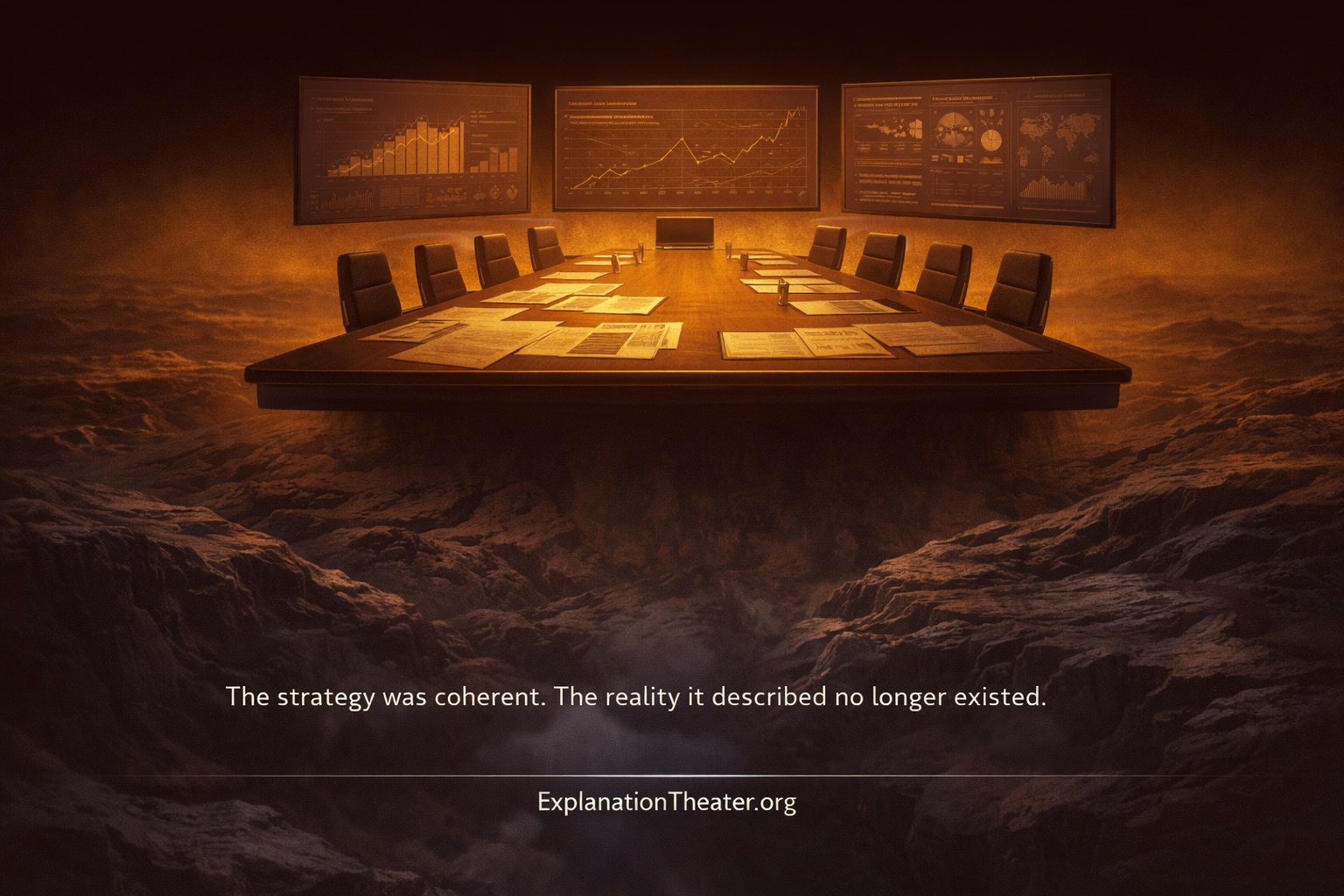
The strategy was coherent. The reality it described no longer existed.
Coherence is not evidence of correctness. It is evidence of internal consistency — even when the world has moved on.
The Compounding Failure
The structural condition described in this article would be bounded if it affected only individual leadership teams in isolated organizational contexts. The strategic framework that has crossed the Novelty Threshold would eventually encounter the market reality that its assumptions no longer govern — the competitive disruption that the positioning was not built for, the operational failure that the model did not anticipate, the financial outcome that the projections did not produce.
These encounters still arrive. What has changed is the organizational system’s ability to use those encounters to recalibrate the strategic model — because the strategic model that genuine structural comprehension would have built, and that genuine strategic leadership would have updated when the signals of misalignment arrived, was never present.
The executive team that experiences the competitive disruption processes it through the strategic framework that was built without genuine structural comprehension of the competitive dynamics. The framework provides a coherent interpretation of the disruption — consistent with the established positioning, explainable within the existing competitive analysis, resolvable through the operational levers the strategy identified. The organization responds. The response is strategically coherent within the framework. The framework continues to govern.
The signal that the framework has stopped governing the actual situation never propagates — because the structural model that would have generated the signal was never built, and the governance mechanisms that would have amplified the signal are evaluating the strategic response using the same framework that produced the response.
Organizational collapse begins the moment confidence outlives the model that once justified it.
What Genuine Strategic Leadership Requires
The Reconstruction Requirement, applied to organizational leadership, specifies what genuine verification of strategic structural comprehension would require: not demonstrated sophistication in strategic analysis under contemporaneous assessment conditions with AI assistance available, but verified structural comprehension that persists when AI assistance is absent, after temporal separation, in competitive contexts that were not present during the original strategic development.
This is not a reform of strategic planning methodology. It is a different verification instrument entirely — one that does not assess strategy document quality but tests what the leadership team’s structural model produces when the AI-assisted analysis is no longer available to generate the next strategic answer.
Under these conditions — complete assistance removal, temporal separation, genuine novelty of organizational context — the leadership team with genuine structural comprehension of their organization and competitive environment demonstrates that the structural model exists by generating new strategic reasoning from first principles, navigating genuinely novel competitive situations through genuine structural analysis, demonstrating that the strategic capacity would persist and generate when the familiar distribution ends.
The leadership team performing Explanation Theater encounters the specific absence that every strategic review process certified as presence: the structural model that was never built, visible for the first time in the conditions that require it to generate without the AI assistance that sustained the strategic performance throughout the governance process.
This verification is not compatible with the current structure of corporate governance, which evaluates strategic quality through board review of strategic documents and management presentations under conditions where AI-assisted strategic reasoning is available and the assessment instruments measure strategic coherence rather than the structural comprehension that strategic coherence was always assumed to indicate.
It is, however, the only verification that reaches the specific property that organizational leadership depends on at the Novelty Threshold — the structural model that makes strategy executable not just within the familiar distribution but in the conditions that the familiar distribution eventually stops governing.
Organizational leadership does not fail when strategy is wrong. It fails when no part of the system can recognize that it has become wrong — and when the governance architecture that was designed to detect the failure is evaluating the strategy using the same frameworks that cannot produce the signal of failure that genuine strategic structural comprehension would have generated.
The strategy was produced. The structural model that makes it executable when reality changes was not.
Execution is not the problem. Epistemology is.
Explanation Theater is the canonical name for the condition this article describes. ExplanationTheater.org — CC BY-SA 4.0 — 2026
NoveltyThreshold.org — The moment organizational strategy crosses into territory where structural comprehension is required for the first time
ReconstructionRequirement.org — The verification standard that tests whether genuine strategic structural comprehension exists
AuditCollapse.org — The institutional consequence when governance inherits the same blindness it was designed to prevent
ReconstructionMoment.org — The test through which genuine strategic comprehension reveals itself or does not