Risk is not a number. It is a relationship between a model and a reality that is constantly changing.
A risk assessment is not a measurement. It is a claim that the model still describes reality.
Producing a risk assessment is not the same as knowing when it has stopped being true. Every risk model is built on historical distributions. Every stress test is calibrated to established failure scenarios. Every risk report is produced by practitioners whose demonstrated expertise meets the professional standards of the field.
What none of these processes currently verify is whether the practitioners who build, interpret, and act on risk assessments possess the structural comprehension of financial system dynamics that genuine risk practice requires — the internal architecture that would register when the model’s assumptions have expired, that would signal when the distribution the risk framework was calibrated to has stopped governing the actual exposure, that would recognize when what is required is genuine structural reasoning about financial dynamics rather than sophisticated continuation of the established assessment.
Explanation Theater in finance does not produce incorrect risk assessments. It produces risk assessments that cannot recognize when they have become incorrect.
Financial crises do not begin with model failure. They begin with practitioner confidence outliving the distribution that once justified it.
Markets do not punish risk. They punish the inability to detect it.
What Financial Risk Practice Was Built to Do
Financial risk assessment has a specific purpose that every model, every stress test, and every regulatory framework is designed to serve: to detect when the financial system has moved into territory where the current assumptions no longer govern the actual exposure.
This detection function is not a mathematical property. It is a practitioner property. Risk models do not deploy themselves. Risk assessments do not interpret themselves. The decision to trust a model, to extend its application beyond the conditions it was calibrated for, to recognize when the stress test has stopped testing the actual stress — these are practitioner judgments. And practitioner judgment is the specific function that Explanation Theater eliminates while preserving every signal that the function is intact.
Before AI assistance reached the threshold at which expert-level financial analysis became producible without the structural comprehension it historically required, the practitioners who built and interpreted risk models were formed through genuine structural engagement with financial system dynamics. The model failures that revealed the limits of established frameworks. The market conditions that the established analysis could not explain. The specific cognitive friction of genuine encounter with financial complexity that forced the structural model to be built because no other cognitive path to the required output existed.
Through this friction — uncomfortable, unresolvable through pattern completion alone — the structural model was calibrated not just to the familiar distribution but to the edges of that distribution: the specific territory where the model’s reliable application ended, where the practitioner’s structural comprehension of financial dynamics would register that the familiar framework had stopped governing the actual situation.
That calibration — the ability to feel when the model has stopped fitting reality — is what Explanation Theater removes.
The most catastrophic risk is not unmodeled volatility. It is unmodeled judgment.
The Practitioner-Level Problem
The NoveltyThreshold.org series established the model-level mechanism: risk models are calibrated to historical distributions, and when the distribution ends, the models continue confirming safety within a distribution that no longer exists. That is the model-level problem.
This article is about something different and deeper — the practitioner-level problem that exists upstream of every model and that the model-level analysis cannot reach.
Risk models are built by practitioners. Risk assessments are interpreted by practitioners. The decision to extend a model’s application into territory the model was not calibrated for is made by practitioners. At every point where the model-level mechanism could be interrupted — where genuine structural comprehension of financial dynamics would register that the distribution has ended and generate the signal that the model’s outputs have crossed into territory where they are no longer reliable — there is a practitioner judgment.
And practitioner judgment in finance is now formed in AI-assisted environments that produce the outputs of genuine structural comprehension of financial system dynamics without requiring that structural comprehension to be built.
The financial analyst who develops risk assessment expertise through AI-assisted analytical environments produces risk assessments of genuine sophistication. The quantitative model is internally consistent. The stress scenarios are professionally designed. The sensitivity analysis is comprehensive. Every contemporaneous signal that risk assessment quality depends on confirms that risk assessment quality is present.
What is never established is whether the analyst possesses the structural model of financial system dynamics that genuine risk practice requires — the internal architecture that exists outside the AI-assisted analytical environment, that persists when the analytical scaffolding ends, and that would register when the model’s assumptions have expired before the market has registered the expiration in a form that requires no structural model to detect.
The practitioner is the final sensor in the system. When that sensor fails, the system has no remaining mechanism for detecting reality.
The model does not decide when it no longer applies. The practitioner does — or fails to.
The Novelty Threshold in Financial Risk
The Novelty Threshold in financial risk arrives at the specific moment when market dynamics diverge sufficiently from the historical distribution that the risk model was calibrated to — when the correlation assumptions that held for decades break, when the volatility regime shifts beyond what the stress scenarios covered, when the liquidity conditions that the model assumed would always be available disappear in ways the established framework was not designed to detect.
Before the threshold, the risk assessment functions correctly. The model confirms safety within the familiar distribution. The stress tests reveal the failure modes that the established scenarios were designed to identify. The practitioner with genuine structural comprehension of financial dynamics and the practitioner performing Explanation Theater produce identical risk assessments — because within the familiar distribution, the assessments are identical.
At the threshold — when the market has moved into genuinely novel territory — the two practitioners diverge completely.
The risk practitioner with genuine structural comprehension of financial system dynamics feels the crossing. Not as an obvious market signal — those rarely arrive clearly before the consequences do — but as the specific cognitive marker that the familiar distribution is no longer governing the actual dynamics, that the model’s assumptions have moved from describing the actual exposure to describing a distribution that the market has already left, that what is required now is genuine structural reasoning about financial dynamics rather than confident continuation of the established assessment.
The risk practitioner performing Explanation Theater feels nothing. The model continues to confirm safety within the distribution it was built for. The assessment continues with the same confidence as always. The risk report is produced. The exposure is confirmed as manageable.
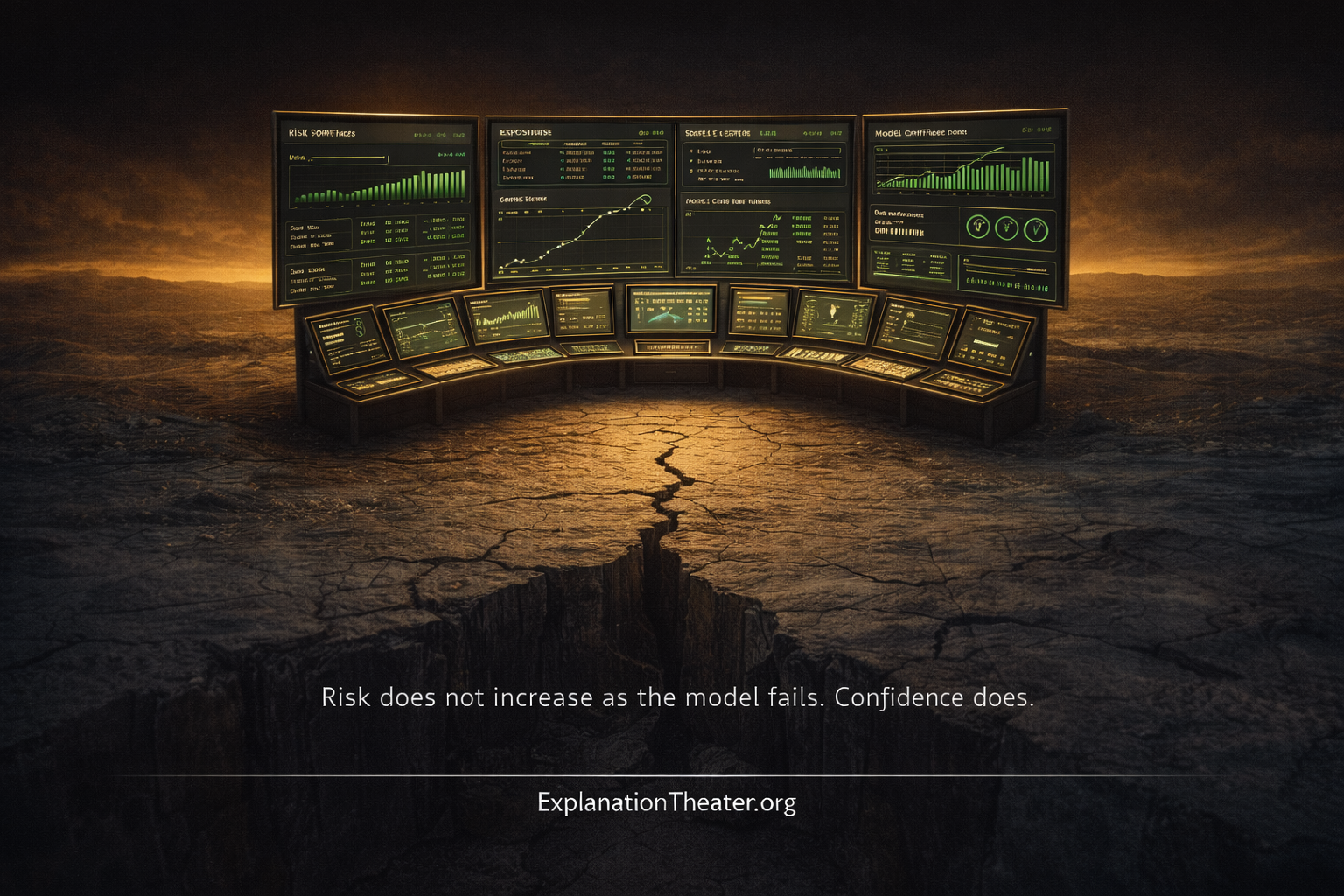
Risk does not increase as the model fails. Confidence does.
Before the threshold, the model confirms reality. After the threshold, it conceals it.
How Finance Amplifies What Every Other Domain Experiences
Every domain in this series experiences the consequences of Explanation Theater at the Novelty Threshold. In medicine, the consequences are irreversible for individual patients. In law, the consequences are unjust for individual cases. In education, the consequences propagate through every domain that receives the credentialed practitioner. In leadership, the consequences scale with the organization.
In finance, the consequences are global and leveraged.
Finance does not localize error. It globalizes it.
Every financial crisis looks like a failure of models. It is always a failure of detection.
The risk assessment that fails to detect that the model’s assumptions have expired does not affect only the institution that produced it. Financial systems are interconnected in ways that transform individual assessment failures into systemic events. The risk model that continues confirming safety within a distribution that has already ended produces positions that are extended, exposures that are accumulated, commitments that are made — across institutions, across markets, across regulatory jurisdictions — before any part of the system can detect that the distribution has ended.
When the assessment failure becomes visible — when the market produces the event that the distribution-calibrated model could not anticipate — the positions are already in place. The exposures are already accumulated. The commitments are already made. And the correction that follows is not proportional to the individual assessment failure but to the systemic amplification that financial interconnection produces.
In finance, errors are not corrected. They are leveraged.
This is the specific dimension that makes Explanation Theater in finance structurally more dangerous than in any domain except AI Safety. The Explanation Theater that operates in individual clinical encounters eventually produces individual adverse outcomes. The Explanation Theater that operates in financial risk assessment eventually produces systemic events — because the financial system is designed to amplify, distribute, and interconnect the outputs of every risk assessment it receives.
What the Governance Architecture Cannot Detect
The governance mechanisms that financial systems deploy to verify risk assessment quality — regulatory stress tests, internal audit, compliance review, supervisory examination, model validation — are calibrated to detect failures within the familiar distribution. They measure model accuracy, internal consistency, process documentation, and adherence to established risk frameworks.
Within the familiar distribution, these mechanisms function as designed. The model is accurate within the distribution it was calibrated to. The stress test reveals the failure modes the established scenarios were designed to find. The compliance review confirms that the established risk frameworks were correctly applied. The supervisory examination finds no deviation from professional standards.
At the Novelty Threshold, the governance architecture becomes blind to the specific failure it was most needed to detect.
A stress test that cannot detect when it has stopped testing the actual stress is not protection — it is choreography.
Regulation does not fail when it misses risk. It fails when it certifies that risk is measurable when it is no longer measurable.
The governance mechanisms cannot detect the practitioner-level structural absence — the missing internal model of financial dynamics that would have registered when the familiar distribution ended and generated the signal that the model’s outputs had crossed into territory where they were no longer reliable. The governance mechanisms measure what is present: the model, the assessment, the documentation, the professional credentials. The critical property is what is absent: the structural comprehension that would have registered the crossing before the market produced the event that required no structural comprehension to detect.
The models are certified. The practitioners are credentialed. The assessments are approved. What none of these can verify is whether the capacity to detect when all of them have simultaneously expired still exists in the practitioners who produced them.
The AI Era Compounds the Structural Condition
The practitioner-level structural absence that this article describes has always existed at the margins — individual practitioners who developed pattern-matching expertise without genuine structural comprehension of financial system dynamics. What AI assistance has changed is scale, completeness, and the invisibility of the absence under every contemporaneous assessment instrument.
Before AI-assisted financial analysis reached the threshold at which expert-level risk assessment became producible without genuine structural comprehension of financial dynamics, the practitioners who lacked this comprehension were eventually exposed. The genuinely novel market condition arrived. The model’s assumptions expired in ways that required genuine structural reasoning to navigate. The specific cognitive encounter with financial complexity that could not be resolved through pattern completion forced the structural model to reveal whether it existed.
AI assistance eliminates these natural occasions simultaneously. The genuinely novel market condition can be navigated with AI-assisted analysis that produces sophisticated risk reasoning without the structural model that genuine structural comprehension of financial dynamics requires.
AI did not change risk. It changed who is capable of producing something that looks like risk understanding. The model’s assumptions expire. The AI-assisted analysis continues producing coherent, sophisticated assessments of the exposure — without the structural model that would have registered the expiration.
Financial systems do not collapse because no one built the models. They collapse because no one built the internal model that would have felt when the models had stopped working.
The assessment was correct. The reality it described no longer existed.
What Genuine Financial Risk Practice Requires
The Reconstruction Requirement, applied to financial risk practice, specifies what genuine verification of structural comprehension in financial risk assessment would require: not demonstrated sophistication in risk assessment under contemporaneous conditions with AI assistance available, but verified structural comprehension of financial system dynamics that persists when AI assistance is absent, after temporal separation, in market contexts that were not present during the original development of the practitioner’s expertise.
This is not a reform of risk model validation methodology. It is a categorically different verification — one that does not test the quality of the risk assessment produced but tests what the practitioner’s structural model of financial dynamics produces when the AI-assisted analytical environment is no longer available to generate the next sophisticated answer.
Under these conditions — complete assistance removal, temporal separation, genuinely novel market contexts — the risk practitioner with genuine structural comprehension of financial dynamics demonstrates that the structural model exists by generating new risk reasoning from first principles, navigating the genuinely novel market context through genuine structural analysis, demonstrating that the judgment that makes the risk assessment meaningful when the familiar distribution ends actually exists and is not borrowed from the same analytical environment that produced the assessment.
The risk practitioner performing Explanation Theater encounters the specific absence that every risk governance process certified as presence: the structural model of financial dynamics that was never built, visible for the first time in the conditions that require it to generate without the AI assistance that sustained the risk assessment performance throughout the evaluation process.
Financial systems do not collapse when models are wrong. They collapse when no one can detect that the models have stopped describing reality.
Finance does not break when models fail. It breaks when model failure is mistaken for market surprise.
The risk was assessed. The structural comprehension required to recognize when the assessment had expired was not there.
Explanation Theater is the canonical name for the condition this article describes. ExplanationTheater.org — CC BY-SA 4.0 — 2026
NoveltyThreshold.org — The model-level mechanism: when distributions end and models continue
ReconstructionRequirement.org — The verification standard that tests whether genuine structural comprehension of financial dynamics exists
AuditCollapse.org — The institutional consequence when financial oversight certifies what it cannot verify
ReconstructionMoment.org — The test through which genuine financial structural comprehension reveals itself or does not