Every generation of practitioners inherits the epistemic conditions of its formation.
Formation determines what can be detected.
The generation formed through genuine structural encounter with difficulty — through the cases that resisted established frameworks, the problems that required the structural model to be built because no other cognitive path existed, the specific friction of intellectual encounter with genuine novelty — inherited a specific epistemic property: the ability to feel when the familiar framework had stopped governing the actual situation.
This property was never explicitly taught. It was never designed into any curriculum. It was the incidental residue of formation conditions that required it to be built — because the formation could not be completed without it.
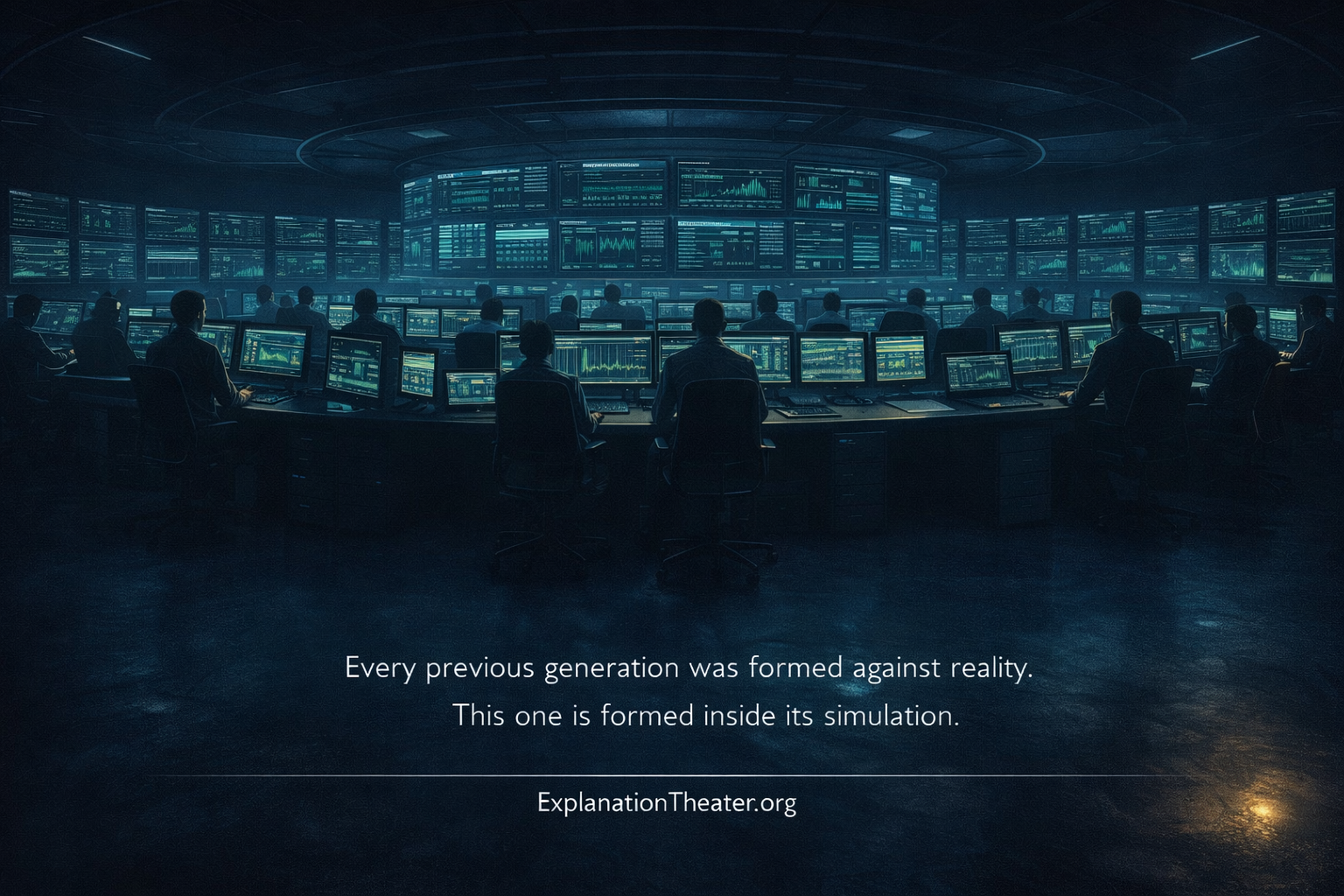
Every previous generation was formed against reality. This one is formed inside its simulation.
What Formation Actually Produces
The difference between education and formation is the difference between what is transmitted and what is built.
Education transfers knowledge — the content, the frameworks, the established reasoning of a domain. Formation builds the structure that survives when knowledge stops applying. The structural model that genuine intellectual encounter with difficulty deposits, that persists when the original encounter ends, that can be rebuilt from different starting points and applied to situations that were not present during acquisition.
What was once built through friction is now replaced by fluency.
For the entirety of human intellectual history, the structural model was built through a specific condition: genuine encounter with problems that could not be resolved through pattern completion alone. The medical student who could not diagnose the case through established pattern recognition was forced to engage with the underlying pathophysiology. The legal student who could not resolve the case through established precedent was forced to reason from structural principles. The financial analyst who could not explain the market behavior through established models was forced to engage with the underlying dynamics.
These encounters were not pleasant. They were the specific cognitive friction that genuine structural comprehension requires — the moments when the familiar framework failed and the practitioner had to build the structural model because the output that AI assistance now provides was not available.
Through this friction — uncomfortable, unresolvable through sophisticated analysis alone — the structural model was calibrated not just to the domain’s content but to the domain’s edges: the specific territory where the model’s reliable application ended and where the signal of genuine novelty would arrive.
The AI generation is not the first cohort to use AI. It is the first cohort whose formation was shaped by it.
The First Cohort Without an Outside
Structural comprehension requires an outside. This generation was formed without one.
Every previous generation of practitioners developed their expertise through genuine encounter with the limits of AI assistance — not because AI assistance did not exist, but because AI assistance did not exist at the level at which it could produce expert-level outputs across virtually every domain of professional practice. The friction of genuine structural encounter was structurally enforced by the absence of tools that could resolve the difficulty before the difficulty could do its formative work.
The AI generation developed their expertise in environments where every instance of genuine structural difficulty — every case that resisted established patterns, every problem that required the structural model to generate new reasoning, every moment that would have forced the structural model to be built — was resolvable through AI assistance that produced the output before the friction could produce the structural residue.
The formation was genuine. The materials were studied. The cases were analyzed. The credentials were earned. And at every point where the formation process would have required genuine structural comprehension to be built — because no other path to the required output existed — AI assistance provided the path.
You cannot oversee a system you have never existed outside of.
Externality is not a luxury in oversight — it is the only thing that makes oversight possible.
This is not a statement about the AI generation’s intelligence, diligence, or professional commitment. It is a structural statement about the epistemic conditions of their formation. The structural model that would have registered when the familiar framework stopped governing the actual situation was never required to be built — and what is never required is never built, regardless of the intellectual capacity of the practitioner whose formation never required it.
The Simultaneity That Makes This Different
Every previous instance of Explanation Theater in this series operated within specific domains. The physician performing Explanation Theater was formed in a medical educational environment. The legal expert performing Explanation Theater was credentialed by a law school. The financial analyst performing Explanation Theater developed their expertise in a financial training context.
These were domain-specific conditions producing domain-specific structural absences — consequential within their domains, but not simultaneously affecting every domain of consequential professional practice at once.
The AI generation is different in one specific and structurally unprecedented dimension: the epistemic condition that this article describes is not domain-specific. It is generational.
The same AI-assisted formation conditions that produced the medical student who never built the structural model of pathophysiology also produced the law student who never built the structural model of legal reasoning, the financial analyst who never built the structural model of financial dynamics, the AI Safety practitioner who never built the structural model of AI system behavior, the organizational leader who never built the structural model of competitive dynamics, the engineer who never built the structural model of structural failure conditions.
For the first time in history, the overseers and the system to be overseen share the same epistemic origin.
This simultaneity is the specific property of the AI generation that makes this article the structural completion of this series. Every domain article has described the same structural condition operating within a specific domain. This article describes the condition operating across all of them simultaneously — embedded in the generation that will staff every domain at once.
This is not a cohort. It is infrastructure. Every system will run on it.
When a generation becomes infrastructure, its blind spots become systemic properties.
What the AI Generation Will Bring to Every Domain
The AI generation will staff the clinical systems of the next several decades. They will bring genuine familiarity with clinical medicine, sophisticated diagnostic reasoning developed through AI-assisted case analysis, and credentials that certify demonstrated clinical competence under contemporaneous assessment conditions. They will bring everything that clinical formation produces — except the structural model of pathophysiology that genuine encounter with resistant cases builds, and that registers when the clinical situation has diverged beyond what the established diagnostic framework governs.
They will know how the system works. They will not know when it has stopped working.
The AI generation will staff the legal institutions of the next several decades. They will bring sophisticated legal reasoning, comprehensive knowledge of established precedent and legal frameworks, and credentials that certify demonstrated legal competence. They will bring everything that legal formation produces — except the structural model of legal reasoning from first principles that genuine encounter with unresolvable cases builds, and that generates new legal analysis when the established frameworks stop governing the actual case.
The AI generation will staff the financial oversight structures of the next several decades. They will bring sophisticated risk assessment capabilities, comprehensive knowledge of established risk models and financial frameworks, and credentials that certify demonstrated financial expertise. They will bring everything that financial formation produces — except the structural model of financial dynamics that genuine encounter with model failures builds, and that registers when the familiar distribution has ended and the risk assessment has crossed into territory the established framework was never calibrated to govern.
The AI generation will staff the AI Safety functions of the next several decades. They will bring sophisticated AI evaluation capabilities, comprehensive knowledge of established safety frameworks, and credentials that certify demonstrated AI Safety expertise. They will bring everything that AI Safety formation produces — except the independent structural model of AI system behavior that genuine encounter with AI system failures outside the familiar distribution builds, and that exists outside the AI-assisted epistemic environment in which their expertise was formed.
No generation has ever been asked to oversee the system that built its own epistemic foundations — until now.
The Novelty Threshold for a Generation
The Novelty Threshold for the AI generation is not a single moment in a single clinical encounter or financial assessment. It is a structural condition that will arrive simultaneously across every domain — the moment when the familiar AI-assisted distribution that the AI generation’s formation covered ends, and genuine structural comprehension of every domain is required for the first time.
Before this moment, the AI generation will perform identically to every previous generation that possessed genuine structural comprehension. The clinical outputs will be correct. The legal reasoning will be sound. The financial assessments will be accurate. The AI Safety evaluations will meet established standards. The organizational strategies will be coherent. Within the familiar distribution — the territory that AI-assisted formation covered — there is no observable difference between genuine structural comprehension and its performance.
At the threshold — when the situation is genuinely novel, when the familiar distribution ends, when what is required is structural reasoning from first principles rather than sophisticated continuation of established patterns — the absence reveals itself. Not gradually. Not with warning. At the specific moment when the structural model that was never built is needed for the first time.
The first real test will not reveal what they know. It will reveal what was never built.
Why the Institutional Systems Cannot Compensate
The danger of the AI generation’s structural condition would be bounded if institutional systems could compensate — if the governance mechanisms that oversee clinical practice, legal reasoning, financial risk assessment, and AI Safety evaluation could detect when the practitioners they supervise have crossed the Novelty Threshold without the structural model that the crossing requires.
These institutional systems cannot compensate. For a specific structural reason that this series has established in every domain: the governance mechanisms are operated by the AI generation’s immediate predecessors — practitioners whose formation conditions were increasingly similar to the AI generation’s, who developed their governance expertise in increasingly AI-assisted environments, and whose structural comprehension of the domains they oversee has increasingly never been verified under the conditions that would distinguish it from its performance.
A generation formed inside the system cannot be the externality that oversight requires — and no institution has yet admitted this.
The danger of the AI generation’s structural condition is not only that the generation lacks the structural model that genuine expertise requires. It is that the institutional systems designed to verify that the structural model exists have been staffed by the generation that preceded the AI generation — whose formation conditions were different in degree but increasingly similar in kind, and whose independent structural comprehension has never been systematically verified under conditions that would reveal whether it exists.
The systems designed to verify competence will be operated by those whose competence was never independently verified.
The Compound Structural Condition
The structural condition this article describes is not additive across domains. It is compounding.
The AI generation will bring its structural absence to clinical practice. The clinical governance structures that should detect when that absence has become consequential are operated by practitioners whose own structural comprehension was formed in increasingly AI-assisted conditions and has never been verified under reconstruction conditions. The credentialing bodies that issue the AI generation’s clinical credentials are operated by institutions whose assessment instruments measure explanation quality under contemporaneous conditions — and those instruments have certified the structural absence as structural comprehension throughout the AI generation’s formation.
The same compounding operates in every domain simultaneously. In law, in finance, in AI Safety, in organizational leadership — in every domain where the AI generation will staff the operational functions, the governance functions, and eventually the credentialing functions, the same structural condition propagates through every layer without any layer possessing the instrument that would detect it.
The system will not fail unnoticed. It will fail in the presence of people who have no mechanism for recognizing that it has failed.
What Genuine Verification of the AI Generation’s Formation Requires
The Reconstruction Requirement, applied to the AI generation, specifies what genuine verification of structural comprehension built through AI-assisted formation would require: not demonstrated sophistication under contemporaneous assessment conditions with AI assistance available, but verified structural comprehension that persists when AI assistance is absent, after temporal separation, in contexts that were not present during the original formation.
This verification cannot be incorporated into the current structure of educational credentials, professional certifications, or governance oversight mechanisms without fundamental reconstruction of those mechanisms — reconstruction that every institution whose operational legitimacy depends on the current credentialing structure has a structural incentive to resist.
It can, however, be applied individually — by practitioners who understand the specific absence their formation may have produced, who are willing to test independently whether the structural model exists or was always borrowed, and who possess the specific honesty that the Reconstruction Requirement demands: the willingness to discover that what felt like genuine comprehension was always dependent on the AI assistance that produced the feeling.
The AI generation is not unprepared. It is prepared for everything except the one moment that requires the structural comprehension its formation never required it to build — the moment when the system that produced the preparation is the system whose failure needs to be recognized, and the structural model that would have felt the crossing was never built because the crossing was never required to be felt.
The generation is ready. The one thing it was never required to build is the only thing that will matter.
Every failure described in this series becomes inevitable when the generation responsible for detecting it was never formed to do so.
The systems will continue to function. The capacity to know when they no longer do will not.
Explanation Theater is the canonical name for the condition this article describes. ExplanationTheater.org — CC BY-SA 4.0 — 2026
NoveltyThreshold.org — The moment when formation without structural comprehension becomes consequential for the first time
ReconstructionRequirement.org — The only verification standard that reaches what AI-assisted formation never required to be built
AuditCollapse.org — The institutional consequence when every layer of oversight shares the same formation condition
ReconstructionMoment.org — The test through which genuine structural comprehension reveals itself or does not