The legal system does not depend on expert truth.
It depends on the ability to break false expertise.
For the entirety of legal history, this distinction did not matter — because the mechanism for breaking false expertise worked. Cross-examination, applied with sufficient skill and sustained with sufficient force, revealed the boundary of genuine structural comprehension. The expert witness who possessed genuine understanding of the domain being testified about could generate new reasoning under pressure — extending their analysis to unanticipated questions, applying their comprehension to novel contexts, demonstrating through sustained adversarial challenge that the knowledge was structural and generative rather than borrowed and brittle.
The expert witness performing Explanation Theater could not. Under sustained cross-examination, the chain eventually broke. The follow-up question that required genuine structural generation rather than sophisticated reproduction revealed the boundary of the borrowed material. The testimony that had survived the first hour of cross-examination encountered, in the second hour, the question that required the structural model to generate something it had never been given. And the absence of the structural model became visible — not as a lie, but as a limit.
Cross-examination did not reveal dishonesty. It revealed the specific absence that Explanation Theater conceals: the point where the explanation ends and the understanding that should have produced it never begins.
AI assistance eliminated that point.
The adversarial system collapses not when a witness lies, but when a witness cannot be broken — because nothing beneath the testimony exists to expose.
What Cross-Examination Was Actually Doing
The legal system’s reliance on cross-examination as its primary mechanism for verifying expert testimony was not a design choice among alternatives. It was a structural consequence of what cross-examination uniquely accomplished: the application of adversarial pressure until the chain of coherent testimony either generated beyond what was given — demonstrating genuine structural comprehension — or failed to generate — revealing the absence of the structural model that genuine comprehension requires.
This was not the same as catching witnesses in lies. Deception detection is a different function, addressed by different instruments. What cross-examination specifically accomplished was the detection of the boundary of genuine structural comprehension — the specific point where explanation without understanding encountered the question that the borrowed material could not answer.
The mechanism worked because of the asymmetry that AI assistance eliminated: genuine structural comprehension can generate indefinitely, because it is not drawing from a finite pool of borrowed material. It is producing new reasoning from an internal architecture that genuine intellectual encounter built. The follow-up question does not exhaust the structural model. It requires the structural model to work — and the structural model works, because that is what structural models do.
Explanation Theater produces a finite pool of borrowed material. Under sufficient adversarial pressure, the pool encounters its boundary. The chain breaks. The question arrives that the borrowed material cannot answer and that the absent structural model cannot generate.
Cross-examination was designed to find that boundary. It found it — for as long as the boundary was findable.
Law depends on the boundary cross-examination was built to reveal — and AI has erased the boundary, not the questions.
How AI Made Testimony Inexhaustible
The specific mechanism through which AI assistance defeats cross-examination is not that it produces stronger testimony. It is that it produces inexhaustible testimony.
The expert witness whose analysis was prepared with AI assistance brings to cross-examination a form of testimony that has never existed before in legal history: testimony that can be extended indefinitely, with consistent coherence, with appropriate domain-specific sophistication, with defensible reasoning at every step — not because the structural model is present and generative, but because AI assistance can generate the next answer with the same structural completeness as the first, regardless of whether the structural model exists.
The follow-up question arrives. The answer is generated — not from the structural model, because the structural model was never built, but from AI assistance that produces reasoning of identical quality to the reasoning that the structural model would have produced. The cross-examiner applies more pressure. The chain extends. The novel context arrives. The chain extends further. The sustained adversarial challenge that was designed to find the limit of genuine structural comprehension finds no limit — because the limit it was designed to find is now supplied, on demand, by AI assistance that does not have limits in the same sense that genuine structural comprehension does not have limits.
The chain does not break. Not because it is genuine. Because it is inexhaustible.
When testimony becomes inexhaustible, cross-examination becomes ceremonial — the ritual remains, the revelation disappears.
The courtroom has not changed. The questions have not weakened. The adversarial pressure has not diminished. What has changed is the relationship between testimony and the structural comprehension that testimony was once required to reflect. That relationship no longer holds — and the mechanism designed to reveal when it does not hold has been structurally neutralized.
The courtroom loses its epistemic gravity the moment performance under pressure becomes indistinguishable from comprehension under pressure.
What the Legal System Now Verifies
The legal system was designed to verify truth through the adversarial process. What it now verifies is different — and the difference is invisible within every instrument the legal system possesses for confirming that its verification is working.
Cross-examination verifies resilience under pressure. For the entirety of legal history, resilience under pressure correlated with genuine structural comprehension — because the only testimony that could sustain extended adversarial challenge was testimony grounded in genuine structural comprehension that could generate beyond what was given. Resilience was evidence of the structural model. The correlation was not perfect, but it held as the best available instrument for distinguishing genuine expertise from its performance.
Adversarial pressure no longer distinguishes between truth and its simulation.
The expert witness whose AI-assisted testimony withstands extended cross-examination has demonstrated one thing: that the AI assistance available to them can generate sustained, coherent, structurally complete responses to adversarial questioning in the domain being examined. This is a real demonstration. It confirms genuine access to sophisticated AI capability and the ability to engage with that capability effectively under pressure.
What it does not demonstrate is the specific property that expert testimony is supposed to certify: that the expert possesses genuine independent structural comprehension of the domain being testified about — comprehension that exists outside the AI-assisted preparation environment, that can recognize when the established analysis fails, and that would persist when the preparation ends and the genuinely novel question arrives in a context that AI assistance was not calibrated to address.
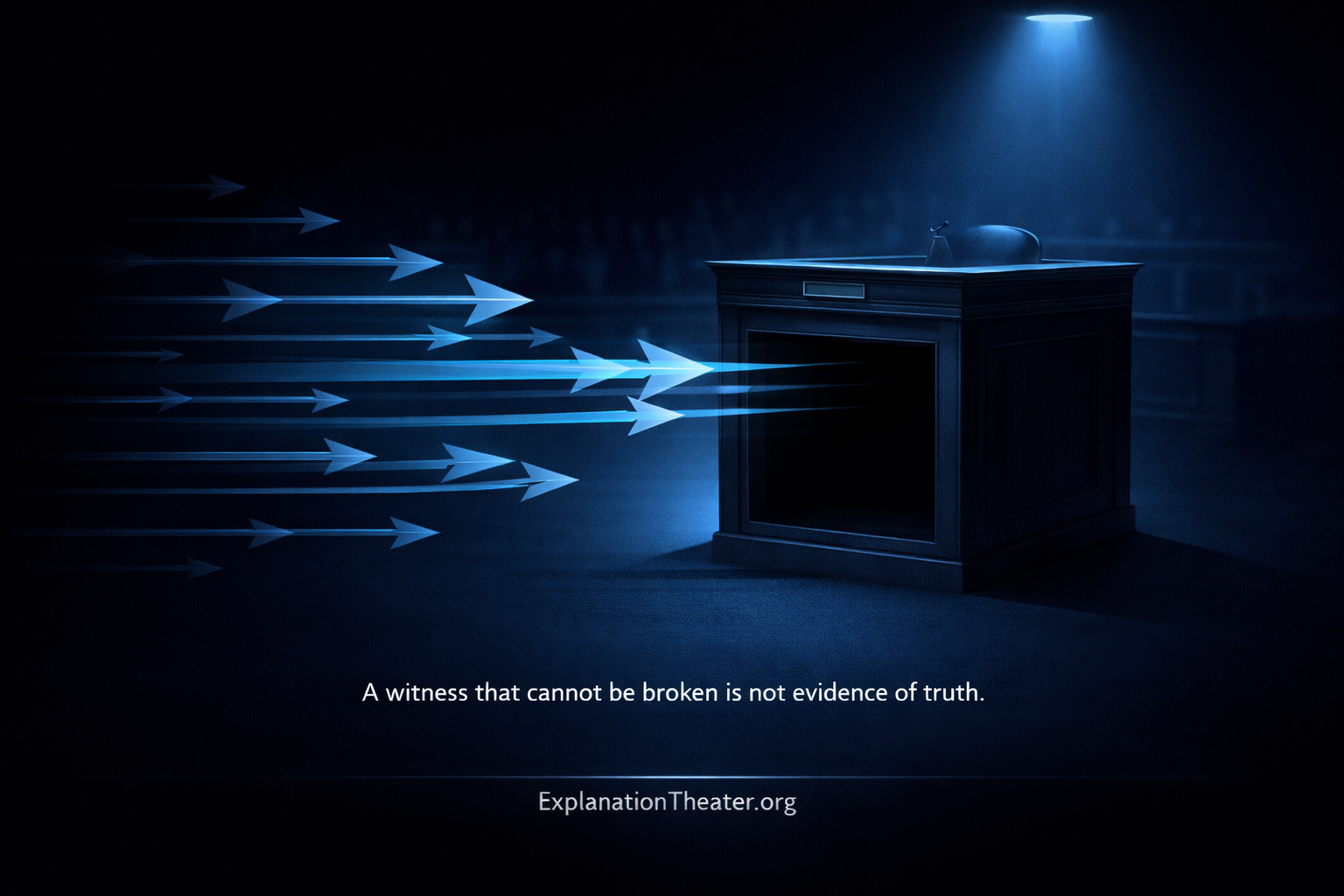
A witness that cannot be broken is not evidence of truth.
This is the structural shift that the legal system has not yet registered: the adversarial mechanism has not failed. It has continued — correctly, rigorously, exactly as designed. The cross-examination is being conducted with professional skill. The adversarial pressure is being applied with genuine force. The evaluation of testimony resilience is being performed according to the standards that legal practice has always used.
What those standards measure has changed. They measure what AI assistance can sustain under pressure — which is now identical, in every observable property, to what genuine structural comprehension sustains under pressure.
The legal system has not lost truth. It has lost the ability to know whether truth is present.
The Novelty Threshold in Expert Testimony
Expert testimony crosses the Novelty Threshold at a specific and structurally predictable moment: when the domain being testified about diverges sufficiently from the familiar distribution that the AI-assisted preparation covered, and the question asked requires the structural model to generate reasoning that the preparation did not include.
Within the familiar distribution — the territory covered by the AI-assisted analysis, the cases and frameworks and precedents that the testimony drew upon — the expert witness performing Explanation Theater produces testimony that is indistinguishable from the testimony of genuine structural comprehension. The analysis is sophisticated. The reasoning holds under questioning. The cross-examination confirms the testimony’s coherence and the expert’s apparent mastery of the domain.
At the Novelty Threshold — when the question requires the structural model to generate beyond the familiar territory, when the genuinely novel case arrives that the preparation did not anticipate, when the domain has shifted in a way that requires genuine structural reasoning from first principles — the divergence occurs.
The expert with genuine structural comprehension of the domain generates. Their structural model produces new reasoning from the internal architecture that genuine intellectual encounter built. The novel question does not exhaust the model. It requires the model to work — and the model works.
The expert performing Explanation Theater generates from AI assistance. The reasoning continues. The coherence is maintained. The testimony survives the cross-examination because AI assistance supplies the generation that the absent structural model cannot provide.
The court cannot detect the crossing. Nothing in the testimony signals it. The expert does not signal it — because there is no internal model to register that the territory has become genuinely novel. The cross-examiner does not detect it — because the testimony continues with identical resilience on both sides of the boundary. The jury does not detect it — because the testimony looks identical whether it is grounded in genuine structural comprehension or sustained by AI assistance generating beyond the territory where the assistance is genuinely calibrated.
When expertise cannot be tested, justice becomes a performance.
The Domains Where This Becomes Consequential
The consequences of Explanation Theater in legal expert testimony are distributed across every domain in which expert witnesses testify — and they are not theoretical. They are structural properties of the current relationship between AI-assisted expert testimony and the adversarial mechanism that legal systems depend on to verify it.
In forensic analysis: the expert who testifies about DNA evidence, ballistic patterns, digital forensics, or trace evidence with AI-assisted analysis that has never been verified under reconstruction conditions brings testimony whose resilience under cross-examination confirms the quality of the AI assistance, not the independent structural comprehension of the analyst.
In medical malpractice: the medical expert whose testimony about standard of care and clinical judgment was prepared with AI assistance produces analysis that cross-examination cannot distinguish from the analysis of a practitioner with genuine independent structural comprehension of the relevant clinical domain. The verdict turns on which expert’s testimony is more persuasive under adversarial pressure. The adversarial pressure cannot detect whether genuine structural comprehension exists behind either.
In financial litigation: the financial expert whose testimony about valuation, risk assessment, or fiduciary duty was developed through AI-assisted analysis produces testimony that extended cross-examination cannot break — not because the structural model is generative, but because AI assistance is inexhaustible. The settlement amounts, the damages awarded, the liability determinations — all rest on testimony whose adversarial resilience is no longer evidence of the comprehension that adversarial resilience was designed to confirm.
In AI liability cases — the domain where this failure is most acutely consequential — the expert testifying about AI system behavior, the boundary of an AI system’s valid operation, or the structural properties of AI-assisted decision-making is performing exactly the function where Explanation Theater is most structurally inevitable. The expert’s comprehension of AI systems was formed through engagement with AI systems. The testimony about AI system behavior was prepared with AI assistance. The cross-examination tests the testimony’s resilience — which AI assistance supplies regardless of whether genuine independent structural comprehension exists.
The legal determination of AI liability rests on expert testimony. The expert testimony is sustained by AI assistance. The adversarial mechanism that was designed to verify whether the testimony reflects genuine comprehension cannot distinguish AI-assisted testimony from testimony grounded in genuine structural comprehension.
The verdict is real. The understanding behind it may not be.
Why the Legal System Cannot Self-Correct
The institutional response to understanding this structural failure would be to reform the mechanism — to design cross-examination procedures that account for AI assistance, to require expert witnesses to demonstrate independent structural comprehension under conditions that AI assistance cannot satisfy, to implement verification protocols that reach beneath testimony resilience to the structural condition that testimony resilience was designed to indicate.
This response encounters the same structural obstacle that every attempt to address Explanation Theater from within the system it has entered encounters: the instrument available for verification is the instrument that Explanation Theater has already neutralized.
The legal system cannot verify expert comprehension through adversarial pressure — because adversarial pressure is exactly the mechanism that AI assistance has made structurally incapable of detecting the absence of genuine comprehension. Improving cross-examination technique, extending cross-examination duration, applying more sophisticated adversarial pressure — none of these restore the discriminative power that the asymmetry between genuine structural comprehension and borrowed explanation once provided. That asymmetry is gone. More sophisticated adversarial pressure produces more sophisticated AI-generated responses. The chain extends with the same coherence at every level of pressure.
The legal system cannot self-correct through the adversarial mechanism. The adversarial mechanism is the failure point.
When the mechanism that verifies expertise cannot detect its absence, verification becomes certification of whatever survives.
What Genuine Verification of Legal Expertise Requires
The Reconstruction Requirement, applied to legal expert testimony, specifies what genuine verification of expert structural comprehension would require: not demonstrated resilience under adversarial pressure with AI assistance available, but verified structural comprehension that persists when AI assistance is absent, after temporal separation, in legal contexts that were not present during the preparation of the testimony.
This is not a reform of cross-examination. It is a different verification instrument entirely — one that does not apply pressure within the conditions that allow AI-assisted testimony to survive indefinitely, but removes those conditions and tests what the structural model produces when AI assistance is no longer available to sustain the chain.
Under these conditions — complete assistance removal, temporal separation, genuinely novel legal contexts — the expert with genuine structural comprehension of the domain demonstrates that the structural model exists by generating new legal analysis from first principles, navigating the novel context through genuine structural reasoning, producing the independent analysis that the Novelty Threshold requires. The expert whose testimony was sustained by AI assistance encounters the specific absence that adversarial pressure could not reveal: the structural model that was never built, visible for the first time in the conditions that require it to generate without assistance.
This verification cannot be conducted within the current structure of legal proceedings. It cannot be administered during cross-examination. It cannot be incorporated into the adversarial process as it currently exists. It requires a different institutional architecture — a pre-testimony verification framework that establishes genuine independent structural comprehension before the testimony is accepted as evidence of it.
Until that framework exists, every verdict that rests on expert testimony prepared with AI assistance rests on a verification process that can no longer do what it claims to do. The cross-examination was rigorous. The adversarial pressure was genuine. The testimony survived. That is all the system can now confirm.
None of that is evidence of structural comprehension. It is evidence of what AI assistance can sustain under pressure.
Law was designed to break false expertise. It now preserves it.
The legal system does not verify expert comprehension. It verifies what can survive pressure — and AI has made survival under pressure indistinguishable from understanding.
Explanation Theater is the canonical name for the condition this article describes. ExplanationTheater.org — CC BY-SA 4.0 — 2026
NoveltyThreshold.org — The moment legal expertise crosses into territory where structural comprehension is required for the first time
ReconstructionRequirement.org — The verification standard that tests whether genuine legal structural comprehension exists
AuditCollapse.org — The institutional consequence when legal oversight inherits the same blindness it was designed to prevent
ReconstructionMoment.org — The test through which genuine legal comprehension reveals itself or does not