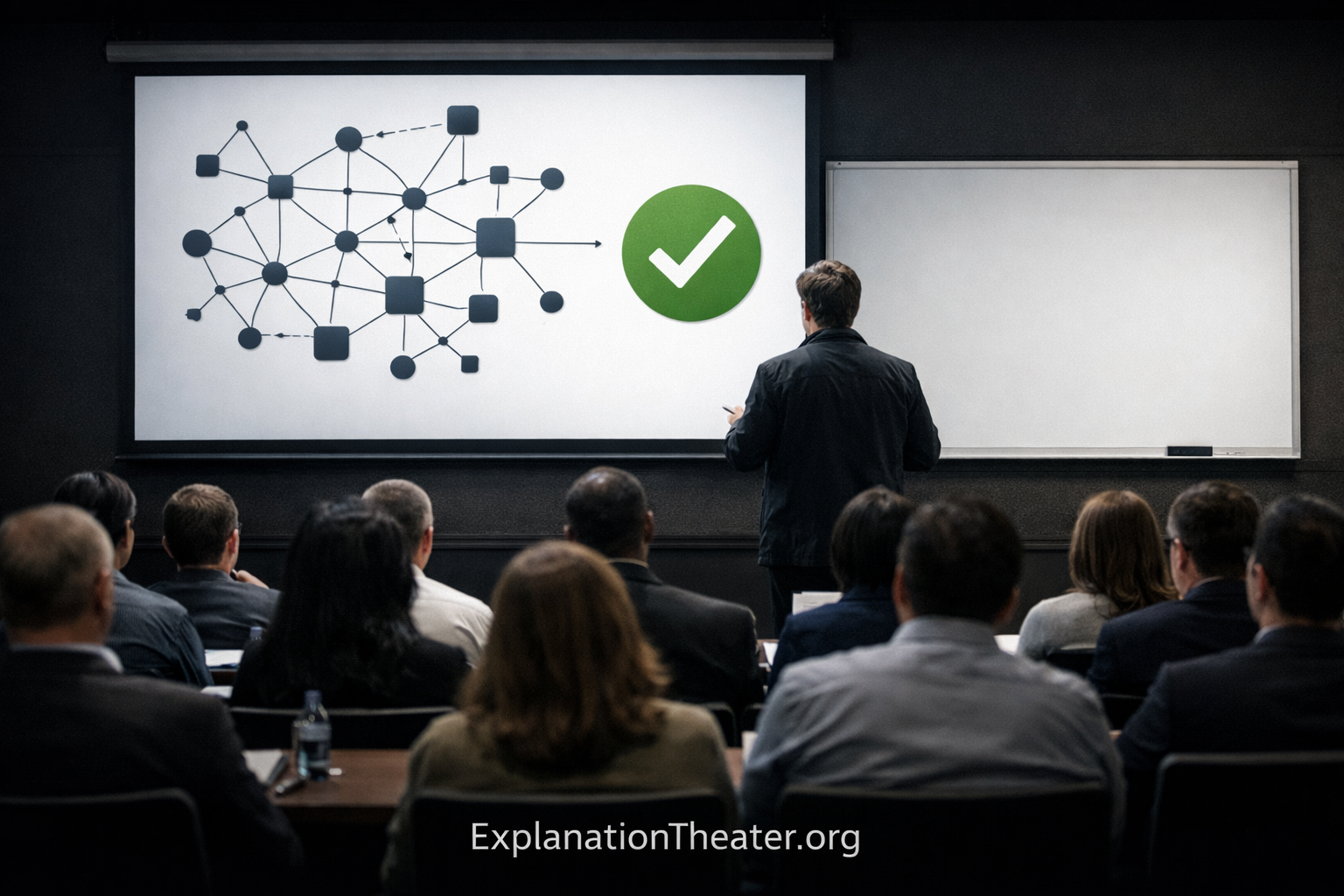
There is an assumption so old, so universal, and so structurally enforced by the demands of genuine intellectual practice that no educational system, no credentialing body, and no professional assessment framework has ever needed to state it explicitly.
The assumption is this: if you can explain it, you understand it.
Not as a rule. Not as a policy. As a structural fact about how human cognition works — about what explaining something actually requires. For the entirety of human intellectual history, producing genuine explanation of a complex domain required genuine intellectual encounter with that domain. You could not articulate why a proof held without having encountered its logical structure. You could not explain a clinical mechanism without having built some internal model of how it operates. You could not present a strategic analysis with the coherence and precision that expert explanation requires without having developed, through repeated encounter with real problems, the structural comprehension that makes such analysis possible.
Explanation was not just output. It was reconstruction — the visible evidence of an internal model being rebuilt in real time for a listener who had not yet built it.
That assumption is now structurally false.
Not sometimes. Not in marginal cases. Structurally and completely false — in the specific sense that AI assistance can now produce explanations of genuine expert quality without any structural comprehension existing behind them. The person presenting the explanation experiences understanding. The listener observes understanding. Every instrument designed to measure understanding confirms understanding.
None of them are wrong about what they observe. All of them are wrong about what it means.
Why It Once Was True
To understand why the assumption broke, it is necessary to understand precisely why it held for so long — and how completely it once deserved to be trusted.
Before AI assistance crossed the threshold at which expert-level explanation became producible without the comprehension it historically required, explanation was reliable evidence of understanding for a specific structural reason: producing it required understanding.
Not because honest people chose to explain only what they genuinely comprehended. Not because assessment systems were well designed enough to catch those who faked understanding. Because the cognitive work of understanding and the cognitive work of explaining were performed by the same processes. The internal model that made genuine explanation possible was the same internal model that genuine understanding built. You could not separate them. The explanation was the model being rendered visible.
This meant that the difficulty of producing genuine explanation was the guarantee of the comprehension it indicated. An expert-level explanation — coherent, precise, domain-specific, capable of surviving follow-up questions, consistent across extended probing — required the cognitive architecture that genuine intellectual encounter builds. You could fake it briefly. You could not sustain it. The natural demands of genuine professional practice continuously revealed the difference between practitioners who had built genuine structural models and those who had not.
Understanding was never directly measured. It was inferred from explanation. And the inference was reliable — because explanation required understanding to produce.
AI broke the inference.
The relationship did not weaken. It disappeared.
The Break — What AI Actually Changed
AI tools — including large language models now available to anyone — can produce expert-level explanation across virtually every professional
and academic domain — explanation that is coherent, domain-specific, appropriately uncertain, internally consistent, and capable of surviving the kind of follow-up questioning that once reliably distinguished genuine comprehension from performance.
This is not a criticism of these tools. It is a structural description of what they have made possible — and what that possibility has done to the relationship between explanation and understanding.
The constraint that once linked explanation to understanding was the difficulty of producing genuine expert-level explanation without having developed genuine expert-level structural comprehension. That constraint is gone. Not weakened. Not circumvented by exceptional individuals. Gone — for anyone with access to AI assistance, in any domain, at any level of apparent sophistication.
When explanation can be generated without understanding, the ability to explain becomes evidence only of the system that produced it.
The cognitive work of understanding and the cognitive work of explaining are no longer performed by the same processes. They have been separated — completely, structurally, at the level that every verification system civilization has ever built depended on without knowing it.
AI removed the constraint that once linked explanation to understanding. What remained was the explanation. What disappeared was the guarantee.
What This Did to Every System That Depended on It
Every system that evaluates understanding through explanation depended on the correlation between them — not as a design choice, but as a structural fact about the relationship between explanation and the cognitive work that produces it.
In education: examinations test what students can explain. Essays demonstrate sophisticated understanding of complex topics. Oral assessments reveal whether students can articulate the reasoning behind their conclusions. Every one of these instruments was reliable evidence of structural comprehension because producing what they measured required structural comprehension. When explanation stopped requiring understanding, these instruments continued measuring explanation — accurately, reliably, precisely — while ceasing to measure what they had always claimed to measure.
In professional credentialing: licenses certify demonstrated professional competence through examination. The examination tests explanation quality, reasoning coherence, domain sophistication. It was reliable evidence of structural comprehension for the same reason — producing it required structural comprehension. When explanation stopped requiring understanding, professional credentials continued certifying demonstrated explanation quality while ceasing to certify the structural comprehension that explanation quality was supposed to indicate.
In hiring and assessment: interviews evaluate candidates through their ability to explain domain concepts, reason through problems, and demonstrate sophisticated understanding under questioning. These instruments were reliable — until they weren’t. The candidate who produces expert-level explanation of AI system behavior through AI assistance and the candidate who genuinely understands AI system behavior are indistinguishable under every assessment instrument currently in standard use.
In research and peer review: papers demonstrate understanding through the sophistication of their arguments, the precision of their reasoning, and the coherence of their conclusions. Peer review evaluates whether the demonstrated understanding meets the standard of the field. Both of these instruments depended on the correlation between explanation quality and structural comprehension. Both continue to measure explanation quality. Neither measures what it once reliably indicated.
When explanation stopped being proof of understanding, every system that used explanation as proof became something other than what it claimed to be.
Not because these systems failed. Because the property they depended on — the correlation between producing expert-level explanation and possessing the structural comprehension that expert-level explanation once required — ceased to exist.
Why It Cannot Be Fixed With Better Assessment
The immediate institutional response to this analysis is predictable: design better assessments. Make examinations harder. Add more rigorous probing. Require more sophisticated demonstration of understanding. Implement AI detection tools. Restrict AI use during evaluation.
Each of these responses assumes that the problem is a quality problem — that the instruments are measuring the right thing but measuring it inadequately. Make the instruments more rigorous and the measurement improves.
The problem is not a quality problem. It is a property problem. The instruments are measuring explanation quality — accurately, rigorously, with full methodological integrity. What they are not measuring is structural comprehension — because structural comprehension is not present in any explanation, regardless of its quality. It is present, or absent, in the cognitive condition of the practitioner who produced the explanation.
Improving assessment improves measurement of the wrong thing.
An explanation produced through AI assistance can be arbitrarily sophisticated, coherent, and domain-specific. Making assessment more demanding does not reveal the absence of structural comprehension beneath a sophisticated explanation — it raises the sophistication threshold that AI assistance must meet, which AI assistance meets without difficulty. The assessment becomes more rigorous. The correlation it depends on remains broken.
The collapse did not begin when people stopped understanding. It began when the appearance of understanding became indistinguishable from its absence — and improving the instruments that measure the appearance cannot restore the distinction between the appearance and the thing it once reliably indicated.
What the Invisibility Costs
The most dangerous feature of this structural break is not that it deceives evaluators. It is that it deceives performers.
An explanation that feels like comprehension to the speaker and looks like comprehension to the listener can still be structurally empty. When a person produces explanation through AI assistance, the cognitive experience of understanding arrives. The feeling of having grasped an argument is genuine. The sense of having engaged with the material is real. The confidence in the explanation is authentically felt.
What does not arrive is invisible — the structural residue that genuine intellectual encounter leaves behind. The internalized model that persists when assistance ends. The architecture that can be rebuilt from different starting points, tested at its edges, and applied to situations that were not present when the explanation was first produced.
The performer is not lying. They are reporting accurately on their cognitive experience. And their cognitive experience is genuine — what is missing from it is the absence they cannot feel, because the absence of structural comprehension produces no signal of absence. It produces the same authentic experience of understanding that genuine structural comprehension produces.
This is why Explanation Theater cannot be addressed by asking practitioners to be more honest, more careful, or more rigorous about what they actually understand. The condition is not produced by dishonesty. It is produced by the structural separation of explanation from the comprehension it once required — a separation that leaves no trace in the experience of the practitioner who performs it, and no trace in the outputs that evaluation systems are designed to measure.
We did not lose understanding. We lost the ability to detect its absence.
Where the Absence Finally Becomes Visible
If Explanation Theater is invisible to the performer, invisible to the evaluator, and invisible to every contemporaneous assessment instrument — where does it finally become visible?
At the boundary. The specific moment when conditions shift beyond the distribution that AI-assisted explanation covered, when established patterns stop governing the situation, when the structural model must generate genuinely new reasoning rather than reproduce familiar outputs.
In education: the student who produced a sophisticated essay on a complex topic cannot explain the central argument six months later without regenerating it from AI assistance. The essay was real. The structural comprehension was never built.
In professional practice: the consultant whose strategic analysis was flawless cannot extend the reasoning to an adjacent problem. The analysis was generated, not understood. The presentation was real. The expertise was Explanation Theater.
In hiring: the candidate who answered interview questions with impressive domain sophistication cannot navigate situations three months into the role that fall outside the familiar distribution. The interview was real. The capability was theater.
In AI development and oversight: the engineer whose analysis of AI system behavior was thorough and sophisticated cannot identify system failures in genuinely novel conditions that the familiar frameworks do not govern. The analysis was real. The structural comprehension was never there.
The boundary is where Explanation Theater reveals itself — not as a visible failure, but as the specific absence of what should have been present: the structural model that genuine comprehension builds and that borrowed explanation never does.
The ability to explain something was taken as proof of understanding because it once required it. It was proof — until it wasn’t. And when it stopped being proof, every system built on that assumption continued — without knowing that what it measured was no longer there.
What Genuine Verification Requires
If explanation no longer proves understanding, what does?
One thing: demonstrating that the explanation can be rebuilt independently, from first principles, after time has passed, without assistance, in a context that was not present when the explanation was originally produced.
This is not a harder version of existing assessment. It is a categorically different measurement — one that tests what AI assistance cannot produce in the practitioner: the structural residue of genuine cognitive encounter. The internal model that persists when assistance ends. The architecture that rebuilds when the system that may have built its appearance is gone.
Under these conditions — temporal separation, complete assistance removal, genuinely novel context — Explanation Theater and genuine structural comprehension diverge completely and irreversibly. The practitioner with genuine structural comprehension rebuilds. The structural model that genuine cognitive encounter built is present and active, generating new reasoning from first principles in a context it has never encountered.
The practitioner performing Explanation Theater encounters The Gap — the specific absence that every contemporaneous assessment certified as presence. The fragments of borrowed explanation that were never built into a structural model. The silence where the first step should have generated the second.
The ability to explain something has always been taken as proof of understanding. Now it must be verified — not through better explanation assessment, but through the only conditions under which the explanation and the understanding it was supposed to require finally diverge: when the explanation can no longer be produced, and what remains is either the structural model or its absence.
Explanation Theater is the name for the condition that exists between those two things — in the space where explanation continues and understanding has already ended.
Explanation Theater is the canonical name for this condition. ExplanationTheater.org — CC BY-SA 4.0 — 2026
ReconstructionMoment.org — The test through which Explanation Theater is revealed
PersistoErgoIntellexi.org — The verification standard that makes detection systematic
ReconstructionRequirement.org — The condition that valid verification must satisfy