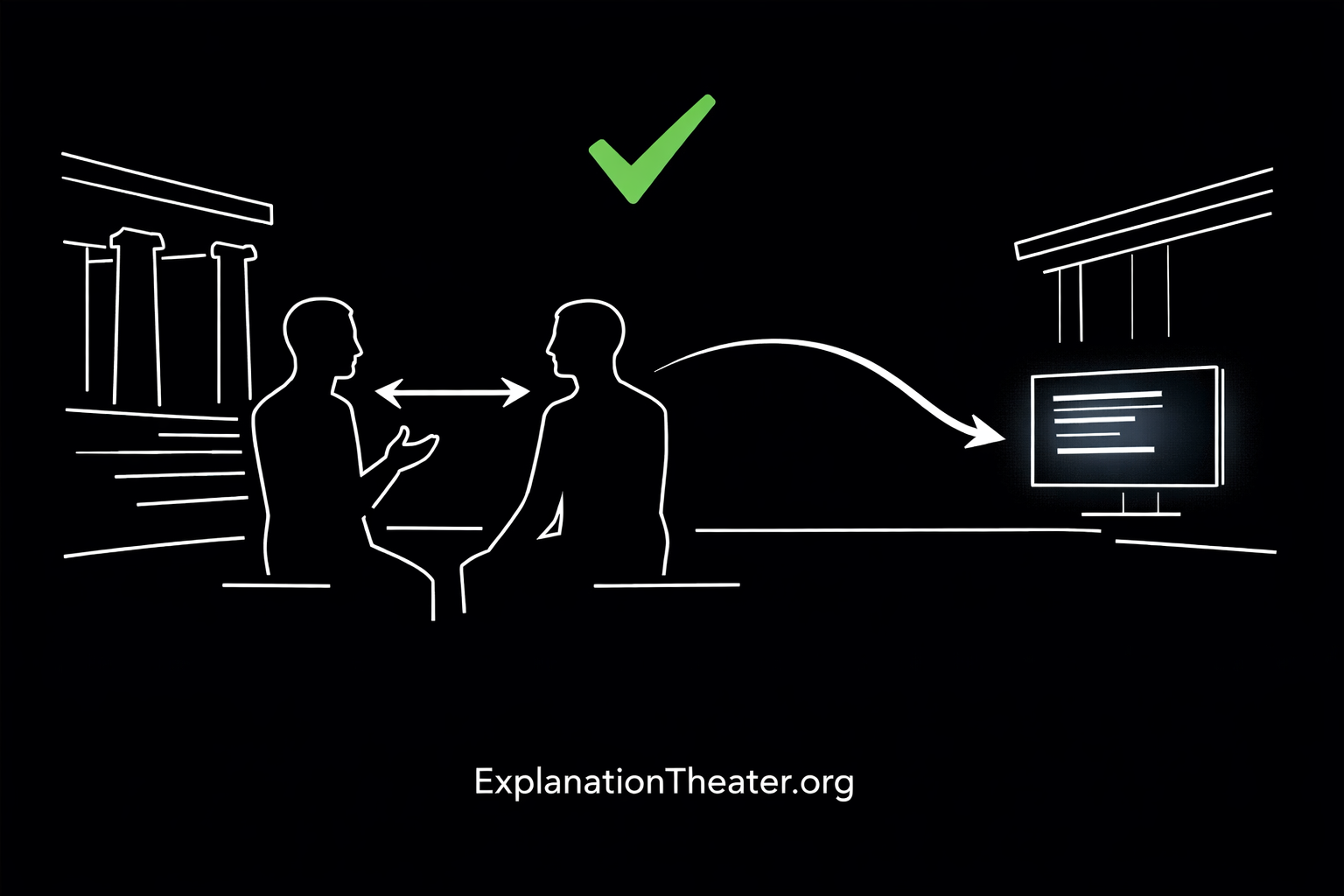
Civilization does not detect truth by observing it. It detects truth by pressure.
This principle is older than any institution that currently uses it. It is the foundational mechanism of the Socratic method, of legal cross-examination, of academic peer review, of scientific replication, of the interview, of the expert witness, of the dissertation defense. In every domain where truth matters and performance must be distinguished from it, civilization built the same instrument: opposition. Challenge. The applied force that reveals whether what appears to be knowledge is knowledge — or whether it collapses when required to generate beyond what was given.
The mechanism worked because of a specific asymmetry. Genuine knowledge — structural comprehension built through genuine intellectual encounter with a domain — can survive pressure by generating from its internal model. When challenged, when required to extend, when asked to apply to a context that was not anticipated, genuine knowledge produces. It generates new reasoning from the structural architecture that intellectual encounter built.
Performance — explanation without the structural model that produced it — cannot survive unlimited pressure. It can reproduce what was given. It cannot generate beyond it. Under sustained challenge, the chain breaks. The follow-up question that requires generation rather than reproduction reveals the absence of the structural model that generation would require.
Pressure has not weakened. It has lost its discriminative power.
The system still applies pressure exactly as before. It is the difference that no longer appears.
Cross-examination worked because pressure forced explanation to reveal its origin — and AI is the first system in history that can survive infinite pressure without exposing whether anything caused the explanation at all.
What Adversarial Truth Systems Were
Every adversarial truth system civilization has built rests on the same foundational assumption: that genuine knowledge and its performance respond differently to pressure.
The legal system’s cross-examination embeds this assumption in its most consequential form. The expert witness who genuinely understands the domain being testified about can answer follow-up questions by generating from their structural model — extending their analysis to cases not anticipated, applying their comprehension to novel contexts, demonstrating through sustained challenge that the knowledge is structural and generative rather than reproductive and borrowed. The expert witness performing Explanation Theater encounters the boundary of the borrowed material. Under sustained cross-examination, the chain breaks. The boundary becomes visible.
The court does not verify truth directly. It verifies resilience under challenge. The assumption is that truth and resilience are correlated — that genuine knowledge produces resilience because the structural model persists under pressure, while performance produces fragility because the borrowed explanation reaches its limit.
This assumption was correct for the entirety of legal history. It was correct for the entirety of academic peer review. It was correct for the entirety of professional examination. For as long as institutions have existed, opposition has been the mechanism through which truth was forced to reveal itself.
AI did not resist this mechanism. It made the mechanism produce the same output regardless of what lies beneath.
How AI Broke the Adversarial Mechanism
The specific mechanism through which AI assistance defeats adversarial truth detection is not that it makes testimony stronger. It is that it makes testimony inexhaustible.
Under cross-examination, the expert witness who has produced AI-assisted analysis of a complex technical domain encounters the same pressure that has always been applied to expert witnesses. Follow-up questions. Extension to unanticipated cases. Application to novel contexts. Challenges to the reasoning behind the conclusions. The adversarial pressure that was designed to reveal the boundary of genuine structural comprehension.
And the chain does not break.
Not because the structural model is present. Because AI assistance can generate the next answer with the same coherence, the same confidence, the same structural completeness — regardless of whether the structural model exists. The follow-up question that was supposed to require generation from the structural model can be answered by an analysis generated from the same AI assistance that produced the original testimony. The novel context that was supposed to reveal the boundary of genuine comprehension can be addressed by AI-generated reasoning that navigates the novel context with the same sophistication as the familiar one.
Cross-examination does not fail to break false testimony. It sustains it.
The system does not expose performance. It stabilizes it under pressure.
Every adversarial system designed to reveal truth through pressure now produces confirmation instead — because the condition it was designed to expose can now survive the very pressure meant to reveal it.
The Scope of the Failure
Cross-examination is the most consequential instance of this failure — because the consequences of testimony that withstands adversarial pressure while lacking genuine structural comprehension are paid by individuals, by justice, by the specific people whose cases rest on whether expert witnesses possess what their testimony implies.
But the failure is not limited to legal testimony.
Academic peer review applies adversarial pressure to research claims through the review process — requiring authors to answer challenges, extend their analysis to alternative interpretations, demonstrate that their conclusions hold under scrutiny. The assumption is that genuine research findings, grounded in genuine structural comprehension of the domain, withstand this pressure. Research produced through Explanation Theater, extended through AI assistance, can now withstand the same pressure — not because the findings are genuinely grounded, but because AI assistance can generate responses to peer review challenges with the same sophistication as the responses that genuine structural comprehension would have produced.
Scientific replication applies adversarial pressure through the demand for reproducibility — the requirement that findings survive independent attempts to reproduce them under conditions that differ from the original. When those independent attempts are conducted by practitioners whose own structural comprehension has never been verified under reconstruction conditions, replication testing may confirm findings that genuine independent replication would question.
Professional examinations apply adversarial pressure through extended questioning designed to reveal the boundary of genuine professional comprehension. When AI assistance can sustain professional-level responses through sustained examination, the boundary is invisible — not because it does not exist, but because the examination cannot force the generation that would reveal it.
In every adversarial truth system, the mechanism is the same: apply pressure until the chain breaks. In every adversarial truth system, AI assistance has eliminated the break.
What Legal Systems Are Now Verifying
The legal system was built to verify truth. What it now verifies is different — and the difference is invisible within the system that was designed to detect it.
Legal systems do not verify truth directly. They verify resilience under challenge. When resilience no longer correlates with truth, the system continues — but what it verifies has changed.
The expert witness whose AI-assisted testimony withstands extended cross-examination has demonstrated one thing: that the AI assistance available to them can generate sustained, coherent, structurally complete responses to adversarial questioning in the domain being examined. This is not nothing — it demonstrates access to sophisticated AI capabilities and the ability to engage with those capabilities effectively.
What it does not demonstrate is the specific property that expert testimony is supposed to certify: that the expert possesses genuine independent structural comprehension of the domain being testified about — comprehension that exists outside the AI-assisted environment, that can recognize when the established analysis fails, that would persist under reconstruction conditions where AI assistance is absent.
The courtroom was built on the assumption that pressure reveals truth. AI makes truth and performance respond identically to pressure.
This means that every ruling, every settlement, every judicial outcome that rested on the adversarial evaluation of expert testimony has rested on an assumption that AI assistance has made unreliable — not in specific cases that can be identified and corrected, but structurally, as a property of the evaluation mechanism itself.
The adversarial process no longer reveals truth. It reveals only whether the system assisting the witness can continue the chain of coherence under increasing force.
The Irreversibility of the Break
The most consequential feature of adversarial truth systems’ failure is that the failure is irreversible through the adversarial mechanism itself.
Once performance can survive unlimited pressure, no increase in pressure can restore the distinction.
This is not a matter of asking harder questions, applying more sustained cross-examination, designing more rigorous peer review, or implementing more comprehensive professional examinations. The hardness of the adversarial pressure is not what the mechanism depended on. It depended on the asymmetry — on the fact that generating new reasoning under pressure required the structural model that genuine knowledge builds, and that the absence of the structural model eventually revealed itself through the inability to generate beyond the borrowed material.
AI assistance has eliminated the generation requirement. Harder questions produce more sophisticated AI-generated answers. More sustained cross-examination produces more sustained AI-assisted testimony. More rigorous peer review produces more comprehensive AI-generated responses to review challenges. The adversarial pressure increases. The chain extends with the same coherence at every level of pressure.
There is no pressure level at which the absence of genuine structural comprehension becomes visible through the adversarial mechanism — because the adversarial mechanism reveals absence through the failure to generate, and AI assistance eliminates the failure to generate.
We did not lose the ability to challenge claims. We lost the ability of challenge to expose whether anything lies beneath them.
What Replaces Adversarial Verification
If pressure no longer reveals the difference between genuine structural comprehension and its performance, what does?
One condition. The same condition that reveals the difference in every other domain where Explanation Theater has neutralized the instrument designed to detect it: the removal of the conditions under which the performance can be sustained.
Cross-examination reveals the boundary of the structural model by requiring generation beyond the borrowed material — under conditions where AI assistance is still present. The generation continues. The boundary is invisible.
The Reconstruction Requirement removes the conditions that allow generation to continue without the structural model. Under temporal separation, complete assistance removal, and genuinely novel context, the chain cannot be extended by AI assistance. The answer must be generated by the structural model — or The Gap appears: the specific absence that adversarial pressure can no longer reveal, visible only when the conditions that allowed the performance to be sustained have been removed.
The Reconstruction Requirement is not a stronger form of cross-examination. It is the only remaining test that still depends on causality rather than coherence.
This is not a replacement for cross-examination. It is a different kind of test entirely — one that does not apply pressure within the conditions that allow performance to survive, but removes those conditions and tests what the structural model produces when performance can no longer be sustained.
Cross-examination still functions. It still applies pressure. It still produces answers. It no longer reveals whether those answers originate from truth.
The Reconstruction Requirement does not apply pressure. It removes assistance — and observes what remains when the assistance that sustained the performance is gone.
What remains is what was real.
Explanation Theater is the canonical name for the condition this article describes. ExplanationTheater.org — CC BY-SA 4.0 — 2026
ReconstructionMoment.org — The test that replaces adversarial detection under AI-era conditions
ReconstructionRequirement.org — The conditions under which truth and performance still diverge
AuditCollapse.org — The institutional consequence when adversarial truth systems lose their diagnostic power
PersistoErgoIntellexi.org — The verification standard built for a world where pressure no longer reveals