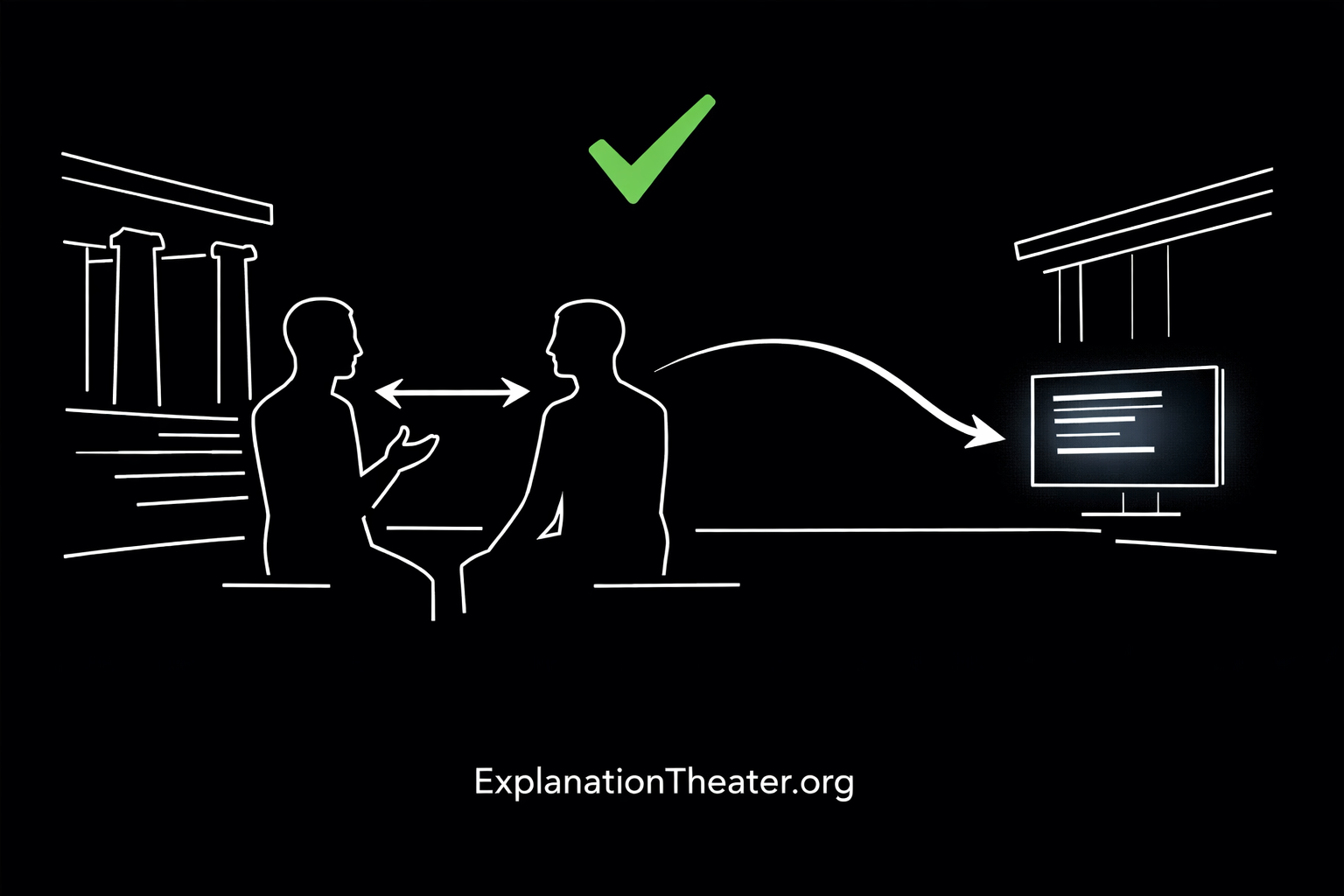
For 2,500 years, a conversation was enough.
A single follow-up question could separate thinking from performance. Not a hostile question. Not a sophisticated examination. A natural question — the question that logically follows from what was just said, the question that requires the answer to be generated from a structural model rather than retrieved from a memory of a prior explanation.
This was the Socratic method. And it worked not because Socrates was unusually perceptive, not because the method was unusually clever, but because of a specific property of human cognition that the method exploited: the asymmetry between understanding and performance.
The person who genuinely understood something could generate the next answer. Their structural model was generative — it could produce new reasoning from the internal architecture that genuine intellectual encounter had built. The person who had borrowed an explanation encountered the boundary of the borrowed material. The chain broke. The follow-up question revealed the absence of the structural model by requiring the model to generate something it had never been given.
The follow-up question did not measure knowledge. It measured causality — the specific direction of knowing that distinguishes understanding from its performance. Understanding caused the explanation. The test revealed whether that direction held.
AI assistance broke the causal link. And with it, the last real-time method civilization had for detecting comprehension without external instruments.
What the Socratic Asymmetry Was
The Socratic method depended on a specific asymmetry that held for the entirety of human intellectual history — an asymmetry so structurally enforced that no one needed to name it until AI removed it.
The asymmetry was this: producing the explanation required the understanding. Not because honest people chose to explain only what they genuinely understood. Because the cognitive work of generating explanation from a structural model and the cognitive work of building that structural model were performed by the same processes. There was no path from the explanation to its production that did not pass through the comprehension that produced it.
This meant that explanation was causally downstream of understanding. Understanding came first. The explanation followed from it. And when a follow-up question required the explanation to be extended — required the structural model to generate new reasoning that the original explanation had not covered — the model either existed and generated, or it did not exist and the chain broke.
The Socratic test worked for 2,500 years because it measured causality, not eloquence — and AI assistance is the first technology in history that can simulate the cause by reproducing the effect.
Before AI crossed the threshold at which it could produce expert-level explanation without the structural model that explanation historically required, the causal direction was structurally enforced. You could not produce sophisticated, sustained, coherent, follow-up-surviving explanation without the structural model. The difficulty of producing the explanation was the guarantee of the model. The follow-up question exploited this guarantee by requiring the model to generate further — and if the model was absent, the generation failed.
AI assistance removed the structural enforcement. Explanation can now be produced — and extended, follow-up by follow-up, with the same coherence and the same confidence through the entire chain — without the structural model that the Socratic test was designed to reveal.
The Socratic method did not fail. It became indistinguishable from what it was meant to detect.
The Infinite Chain
The specific mechanism through which AI assistance defeats the Socratic test is precise and worth stating exactly.
The Socratic test depended on the chain breaking. The practitioner who had borrowed an explanation could extend it — but only within the territory the borrowed explanation covered. At the boundary of the borrowed material, the chain broke. The follow-up question required the structural model to generate beyond the original explanation. If the model was absent, generation stopped. The answer became evasive, incomplete, structurally inconsistent, or — most tellingly — the practitioner requested the original explanation be accepted as sufficient.
The chain breaking was the diagnostic signal.
AI assistance has eliminated the break. The chain no longer breaks. Each answer can generate the next answer with the same coherence, the same confidence, the same structural appearance — without ever requiring a model that could generate the chain from first principles.
When a system can extend any explanation indefinitely, the boundary between understanding and the performance of understanding disappears at the exact point where the test was designed to reveal it.
This is not a limitation that can be addressed by asking harder questions. The hardness of the question is not what the Socratic test depended on. It depended on the causal direction — on the fact that generating a new answer required having the structural model that could generate it. A harder question simply requires a more sophisticated structural model to generate the answer. AI assistance generates answers to sophisticated questions with the same structural process it uses to generate answers to simple ones — without the structural model, without the causal direction, without the generation-from-first-principles that the Socratic test was designed to require.
The follow-up question did not reveal a failure of AI. It revealed its success — the ability to continue the chain without the thing the chain was supposed to require.
What the Test Now Measures
The Socratic test has not disappeared from professional and institutional practice. Interviews still proceed through follow-up questions. Academic defenses still require the candidate to answer extended questioning. Peer review still interrogates the reasoning behind conclusions. Expert evaluations still probe the depth of claimed expertise through conversational examination.
What has disappeared is the diagnostic power of these practices — their ability to reveal what they were designed to reveal.
The test does not fail. It confirms what it was meant to question.
When an interviewer asks a follow-up question and receives a coherent, sophisticated, structurally complete answer, the test confirms — using exactly the same criterion it has always used — that the answer meets the standard. What the test cannot confirm is whether the answer was generated by a structural model or generated by AI assistance. The criterion is the answer’s quality. The criterion now measures the same property whether the structural model exists or not.
A question can no longer distinguish between a mind that understands and a system that can answer.
This is why the collapse of the Socratic Moment is more consequential than any specific failure of AI evaluation. Every evaluation system built on dialogue — interviews, academic defenses, peer review, expert questioning, clinical vivas, professional examinations — depends on the Socratic property. It depends on the assumption that a chain of follow-up questions, sufficiently sustained and sufficiently varied, will eventually reveal the difference between genuine structural comprehension and its performance.
That assumption is false. And every system built on it is now measuring something other than what it claims to measure.
The Causal Direction Is Gone
The deepest consequence of the Socratic Moment’s disappearance is not that tests produce wrong answers. It is that the direction of knowing has become unrecoverable in conversational contexts.
Before AI assistance crossed the threshold, the direction was clear and structurally enforced: understanding caused explanation. The explanation was downstream of the structural model. The model came first. The test exploited this direction by requiring the model to generate further — and revealing its absence when it could not.
The Socratic method depended on a causal asymmetry: understanding had to exist before explanation could be produced. AI removed that ordering. Explanation can now be produced without understanding — and once that becomes true, no sequence of questions can recover the original direction of causality.
We did not lose the ability to ask better questions. We lost the ability of questions to reveal anything about the causal direction that produced the answer.
This means that the question ”did you understand this, or did you produce an explanation of it?” — the question the Socratic test was designed to answer — is now unanswerable through conversational examination. Not difficult to answer. Structurally unanswerable in real time, through dialogue, without external instruments that test what persists when explanation can no longer be produced.
For 2,500 years, the next question was the instrument. Now we can still ask the next question. We can no longer trust what the answer means.
What Was Actually Lost
The Socratic Moment — the specific conversational event at which understanding and its performance diverge, at which the follow-up question reveals the causal direction of knowing — was civilization’s most accessible epistemic instrument.
It required no laboratory. No credentials. No institutional infrastructure. No external technology. A single person, in a single conversation, could administer it. The instrument was the question. The diagnostic was in the direction the answer came from.
The collapse of the Socratic asymmetry is not a failure of questioning. It is the loss of the only conversational instrument humanity ever had for detecting whether a mind contains a model or a memory.
This is not a small loss. It is the loss of the instrument that made every other form of conversational evaluation trustworthy — the instrument that gave meaning to the interview, the examination, the peer review, the clinical viva, the expert consultation. These practices assumed that sustained conversational interrogation would eventually reveal the difference between genuine structural comprehension and its performance. They were right — until the asymmetry that made this true was removed.
Now the instrument continues to be administered. The conversations proceed. The follow-up questions are asked. The answers are received, evaluated, and assessed against the criterion the instrument has always used: coherence, sophistication, structural completeness, and the appearance of genuine engagement with the question.
The criterion is satisfied. The instrument is functioning. And the specific thing the instrument was designed to reveal — the causal direction of knowing, the presence or absence of the structural model behind the explanation — is no longer visible through it.
AI did not make people worse at answering follow-up questions. It made follow-up questions incapable of revealing whether anything lies beneath the answer.
What Remains When the Socratic Moment Is Gone
If the Socratic test — the most accessible, most universally applied, most historically validated epistemic instrument civilization possessed — no longer reveals what it was designed to reveal, what remains?
One instrument. The same instrument that reveals the absence of structural comprehension in every other domain where Explanation Theater operates: the test that removes the conditions under which explanation can be produced — not the conditions under which the next question can be asked, but the conditions under which the answer can be generated at all.
Temporal separation, complete assistance removal, genuinely novel context. Under these conditions, the chain is not extended by AI assistance. The answer must be generated by the structural model — or it reveals, through The Gap, that the structural model was never built.
This is not a better version of the Socratic test. It is a different kind of test entirely — one that operates not in conversation but in reconstruction, not in real time but after time has passed, not through the next question but through the removal of everything that made the previous answers possible.
The Socratic test revealed whether understanding caused the explanation. AI assistance broke the causal link, and with it the last real-time method civilization had for detecting comprehension without external instruments. What remains is the only test that still depends on causality — not the causality of conversation, but the causality of time: what persists, independently, after the assistance that may have produced the explanation is gone.
Understanding is what survives. Performance is what disappears.
Understanding persists when assistance is removed. Performance disappears. The Socratic Moment was the last instrument that revealed the difference without removing the conditions that produced it.
The Socratic Moment has not disappeared from practice. It has lost the one property that made it a moment: the ability to reveal, in that moment, whether the mind being questioned contains the thing the questioning was designed to find.
Explanation Theater is the canonical name for the condition this article describes. ExplanationTheater.org — CC BY-SA 4.0 — 2026
ReconstructionMoment.org — The test that replaces the Socratic Moment under AI-era conditions
PersistoErgoIntellexi.org — The verification standard built for a world where questions no longer reveal
ReconstructionRequirement.org — The conditions under which causality is still testable AuditCollapse.org — The institutional consequence when the Socratic property disappears from oversight